

Sagrado Corazón
By Lina Ferreira Cabeza-Vanegas


I was fifteen in the year 2000. Turn of the millennium, turn of tables and tides. Every morning there were reports on the radio, and every night the news showed footage of the peace talks between the Colombian government and the FARC forces. Folding tables and plastic chairs in a room with no walls, and I don’t think anyone really thought anything would come of it.
Still, we watched. The future of our country on the screen and on a precipice. History about to reassert itself or buckle under the demands of men in linen shirts and bootlegged fatigues. At 9 P.M. every night between 1999 and 2002, the cameras settled on sweat-stained shirts and stern faces to capture the exact moment when we would all be remade with the stroke of a pen and a handshake like fishermen in a Bible verse. Microphones, dress shoes, and rifles. What’ll happen next? we asked. Stay tuned, they said.
On Sunday night, May 14, it was the same. What will happen next? We’ll have to see. I washed my shoelaces in the bathroom sink for Monday school-uniform inspection before morning Mass, while three hours north of Bogotá, a man carefully packed explosives into a PVC pipe frame, like a hermit crab slides a soft body into a borrowed shell.
***
My mother went to school with nuns; my father went to school with priests. So, when it came time to enroll their daughters, they searched high and low for the furthest thing from a Catholic education that Bogotá had to offer.
Not an easy task.
In 1902, the poet-president, José Manuel Marroquín, in an effort to heal the wounds left by the War of a Thousand Days, consecrated Colombia to the Sacred Heart of Jesus. And though the solemn consecration was effectively voided by the revised constitution in 1991—to prevent religious discrimination—no one seemed to notice, or care. In 2008, the Catholic Church renewed the consecration, and once more made Colombia officially “el país del Sagrado Corazón de Jesús.”
The options were few and strange, but eventually my parents settled for a Montessori-style school founded by a former nun, located far out in the countryside beside a small eucalyptus forest and a canal flowing slowly with sewage and green rot.
So, at the age of five, every morning, along with my elder sister, in our uniforms and wool ruanas, we stepped into thick Andean mist. We navigated by memory through the walled-in collection of houses where we lived, as if walking through clouds of milk steam, as if through the blurry corners of end-of-the-world maps. Most days the fog had cleared by the time we joined the huddle of bloodshot-eyed children, yawning and gripping lunch boxes, though sometimes it never seemed to lift at all. Nearby, a guard with a loaded shotgun sipped coffee from his thermos while waiting for cars and vans to take us to schools scattered across the city.
I remember brown birds bathing in the gutter, stray dogs barking in the distance, and the voice of morning radio hosts rising from the guard’s portable AM radio. Fútbol scores, daily bombings, chatter about that Sofía Vergara—“Did you see her? Barely seventeen and nearly naked in that Pepsi commercial, all of Latin America is gonna see it too? They’ll know soon how beautiful Colombian women are”—and the latest news about Lucho Herrera’s race. “La Vuelta a España, il Giro d’Italia, le Tour de France. ¡Ahí va nuestro Lucho! Our Lucho. Go, Lucho, go!” Until finally, a sheet-metal Renault 4 that rumbled like stagehand thunder cut through the fog with blinding high beams, and we were told, “Hurry up, get in, let’s go!”
***
We don’t know much about this man and this night. A few facts only:
Around four in the morning he, along with at least two others, walked through the front door of a home called Hope, in an area known as Sanctuary, on a street named Palestine. La Esperanza, El Santuario, La Palestina. One that Ana Elvia Cortés Gil shared with her husband, Salomón Pachón.
The men wore ski masks and military fatigues, and they wanted money.
There is disagreement about nearly every other detail in the reports.
Sometimes the men arrived at three in the morning, sometimes at four. Sometimes there were three of them, and sometimes more. Always, though, it ended with a single woman with a single bomb strapped around her neck.
Was there a knock, a whistle? A hand sliding back the curtains, and then sliding back locks so the rest could slither into the house like mustard fog and black mist, so they could place their hands on sleeping bodies like orderlies, like exorcists, like rubber-gloved men on slabs of live-wire eels?
Was the bomb zipped into an old-school backpack? A hit man’s duffel bag? Wrapped in newspaper and bubble wrap, tied up with old shoelaces and string? Placed carefully into a plastic grocery-store bag and held carefully in both arms like a sleeping baby, like an egg on a spoon, like a bowl of water filled to the brim? Like a ticking bomb?
Perhaps they put the bomb down gently beside a potted plant, and they kicked down a flimsy wood-panel door that went flying in splinters, wood chips, and loose hinges. The sole of a boot, the crack of a door, and the sound of men yelling, “Malparidos, hijueputas, ahora sí que sí!” Wake up, motherfuckers, now you’ll see what’s what!
***
We started running bomb drills in school after a rumor got around that Pablo Escobar—or maybe Rodriguez Gacha, or the Ochoa brothers, or who knows who and who cares now—were planning to bomb a school in Bogotá.
On November 27, 1989, the FARC took down a plane from a commercial airline, and 107 people with it. Avianca Flight 203 from Bogotá to Palmira, which a man who would later become president was scheduled to board but was miraculously spared by a last-minute change to his schedule. He later said, “Thank Jesus, thank the angels! Divine intervention is what it is.”
At 7:11 A.M. the plane lifted off; at 7:12 the wheels retracted and ears began to pop; at 7:13 nervous passengers were gripping the crosses around their necks and whispering prayers; at 7:14 they had likely reached six thousand feet and the earth seemed like nothing from afar. At 7:15 it began to feel normal again—we can become accustomed to anything at all, even this: air, and speed, and planes like potbellied birds puttering across a lake-blue sky; at 7:16 it was over. A roaring fire at ten thousand feet, spinning shrapnel like a halo of teeth, and a spinning crown of metal thorns.
What was left of the flight and the 107 casualties landed in Soacha, less than a two-hour drive from where I spent most of my childhood. Years later, when a woman who saw the plane fall told me that it looked like “a trash heap, but on the regular ground, that’s all.” Pale ash, white paint, low red flames, and charred-black bodies. “Just like that,” she said. “A regular trash heap, but with people in it.”
So we ran the drills, because in the nineties, everything seemed possible. It is unclear now if school bombings were ever on the table, or on anyone’s mind, back then. But, see, that’s the point of terrorism. Oh, the places you will bomb!
Teachers arranged us in groups down the main building’s hallway. They paired and unpaired us, told us to stand up straight, to sit in circles, to cross our legs and then to kneel, to keep our eyes wide open, then to keep them shut, and pray. “Ángel de mi guarda, mi dulce compañía, no me desampares ni de noche ni de día.” To never, ever run until we were told to. “Oh, my guardian angel, my sweet company, never, ever leave me, night or day, whatever may be.” And we watched them wave their arms like flight attendants, raise their voices, and pace up and down that hallway as if trying to correct the course of a river with nothing but a paper cup, while we traded snacks and marbles and hoped for rain so they would have to keep us inside. Maybe, I remember thinking, they’ll let us watch One Hundred and One Dalmatians again, or maybe it’ll rain so hard and so long I’ll have to climb a tree and live up there until the rain washes every bad thing away. Maybe it’ll never stop.
Because, though no one said it aloud, we weren’t scared. We were too odd, and too small a school, to matter, and our insignificance kept us safe. So we traded marbles; we hoped for rain.
***
The most likely scenario is that the men neither slid in nor slithered out. Men who dream up bombs you can strap around women’s necks are not creatures of nuance and subtlety.
Instead, they probably kept it simple: Cut the lights, poison the dogs. Take four explosive-filled sections of PVC pipe that fit around Doña Elvia’s neck, strap them on, tape them up, leave prerecorded instructions behind.
In an article in El Tiempo, a journalist who had been allowed to listen to the tape described the voice as “nasally,” and “cavernous, but with excellent pronunciation.”
“Pay close attention,” it said, “Mr. Pachón and Mrs. Cortés. This collar is a bomb. And you have ten hours.”
***
The doors rattled like a mouthful of loose teeth. The small car masquerading as a school bus groaned like the bending of metal beams. Backpacks, and knees, and elbows, and jaws. Faces smooshed against the glass as parents made the sign of the cross from their front doors, again and again, like blowing kisses, like throwing darts.
A yellow Renault wedged inside Bogotá traffic and kids wedged inside it.
But not me.
I was five; I was small. I sat in the front seat on the eldest girl’s lap until we reached the right intersection at the right time. A red light and a bus or truck by the passenger window. Then she would gently push me off her lap and very, very slowly begin inching up her skirt.
Andean mist and a Jehovah’s Witness named Marlén at the wheel. Condensation settled on the windshield, and Marlén wiped it away furiously, one hand on the window, one hand on the gear shift, one foot on the clutch as she barked to the eldest girl, “Andrea! Turn signal’s broken again. Lower your window. Signal with your hand.”
At first no one but me and the man in the truck would notice how she placed her hands on her lap and began tugging on the fabric. Then only Andrea and I noticed how the man began to lean out his window, how he stared at her skirt like a plaid curtain on a pale stage. At fingers like inchworms measuring the length of a teen girl’s thighs, and even now, I’m in awe of how perfectly she timed it. Slowly, methodically, the hem of her skirt moved like a minute hand ticking back, back, closer, closer, higher and higher under the red glow of a stoplight. While a truck driver’s eyes grew wider and wider, and he leaned farther and farther out. A stop-motion race toward a finish line she never reached, because then the light turned green, then Marlén finally noticed, stepping on the gas and yelling, “Andrea! Not again!”
***
White walls, clay tiles, and red flowers out front. This was the home where she raised her sons and planted her corn. Where she raised her chickens and fed her dogs. Where she fell asleep to the sound of her husband’s breathing, or to the croaking sounds of an Andean night. A wool sweater, a brown jacket, her breath rising like steam as she rubbed her hands together and began to milk her cows. Maybe she hummed to herself, maybe she loved quiet mornings. Nothing but the ticking of her wristwatch counting down the minutes left of darkness. “She was a hardworking woman,” they said, “muy trabajadora.” “Started up around four,” waking and working and milking and dragging that metal milk container down a gravel path to the edge of a dirt road so she wouldn’t miss the truck that came to collect it, that went off to sell milk in the nearby town.
I lived in a small town when I was five, not far from roads like those of La Palestina. A milkman came to our doorstep with his own metal container. So this is how I picture her. A sweater, an apron. Milk foam, calloused hands. Strong coffee and persistent mist while she pours in perfectly measured motions.
***
Some reports are vaguer than others.
Spanish lends itself to fogginess and ambiguity. Se rompió, se quemó, se mató, se voló, se escapó, se cayó, se suicidó. Reflexive, blameless verbs with tacit, free-radical pronouns. “It felt,” “it flew,” “it fled,” “it fell.” “It burned itself down,” “it blew itself up,” “it cut itself to pieces.”
War was started.
Peace is being negotiated.
The call was made.
Some reports point to a neighbor making the call; others, though, unequivocally state that it was Salomón, Doña Elvia’s husband, clutching the receiver. “Please,” I imagine him saying, “send someone. Please.”
But then, regardless of who made the call, the person on the other end would have had to have asked, “What has happened?”
“There were these men, this morning … Three, maybe four of them? At three, maybe four in the morning? Do you see? They wore ski masks and fatigues, not the official kind, you know … You know who. Yes, like that. They had a backpack, or a grocery bag, or a rain-soaked cardboard box, then they pulled this thing out of it and strapped it around a woman’s neck.”
By 5:20 A.M., the police were on their way.
Nine hours left.
***
The police were called in, and then they called a man by the name of Jairo Hernando López. A man who had been, at that very moment, sitting down for breakfast in a home he shared with his siblings, his mother, his wife, and his five-day-old son.
According to an article written by the journalist David Leonardo Carranza Muñoz in May 2016, Jairo’s mother was already making lunch plans while he, home for the day, asked her not to be too stingy with the chicken. “Put a whole lot in it,” he said. “Not all rice, lots of chicken too.” And I imagine her lifting the lid, puffs of white-rice steam and white-meat smoke, while white mountain mist taps on the window and the radio announcer recites soccer scores, peace talk reports, casualty numbers, and news of Juan Pablo Montoya in the Indy 500. “Formula 1! First Colombian, bet they didn’t see that coming. Won’t see him coming either. Go, Juan Pablo. Our Juan Pablo. Go!” Then the phone rang.
Hushed tones and clipped sentences. “I’m going to Chiquinquirá,” Jairo López tells his family, hanging up the phone, “because there’s a hell of a mess over there.”
Eight hours left.
***
The men wanted fifteen million pesos delivered by that afternoon.
Simple.
About ten hours. About seventy-five hundred dollars.
Not simple at all.
“But we don’t have that kind of cash,” Doña Elvia and her husband replied, according to a Revista semana article published on June 19, 2000.
“Not you,” the men in ski masks said, in a house surrounded by the dead bodies of poisoned farm dogs. “But one of your sons. He works at a bank. Tell him to get it.”
Fifteen million pesos. Seventy-five hundred dollars. Ten hours.
This is, for most people in the world, even now, an exorbitant sum. And even more so for fifty-three-year-old Ana Elvia Cortés Gil, who woke up every morning to wade through heavy mist so she could feed a dozen chickens in the yard, milk six cows in the field.
In many ways, however, this also seems a paltry sum. Insignificant, really.
Not by inflation or adjustment, but by sheer cosmic contrast.
A seven-pound head, almost one grand a pound, all things remembered and forgotten, all things learned, all things ignored, the private nicknames for her sons, the songs she sang to them, the trouble they caused, the stories they told, the way her own mother would hold herself during Mass, how she remembered this, how she forgot that, the sound of her husband asleep beside her, the one thing she thought about once a month but never told a soul. Every single thought she’d ever had, every word she would ever speak, every prayer she had ever prayed.
***
“We switched from normal skirts to jumper dresses,” a former priest turned disciplinary director explained as he gave me a tour of my new all-girls Catholic school, “to reduce the temptation for girls to roll up their skirts and parade around like common streetwalkers.”
I am not Catholic, not really. Except I am Colombian, which is close to the same. And I wanted to get out. I wanted Colombia in a rearview mirror. “Please,” I told my parents at the age of fourteen, “put me in a real school.”
So, until graduation, I wore a uniform designed to thwart temptation. I waited for a bus at six in the morning and stood in line at seven thirty for uniform inspection. Straight spine, plaid jumper knee-high socks, and cold knees. A blue veil of mist around us and a painted-blue veil around the statue of the Virgin before us, while we begged in unison for our guardian angels to protect us, to never leave us, never, never. Not in the day, not in the night. Not until we were at peace with all the saints—Jesus, Joseph, and Mary.
One, two, three. Cross.
One, two, three. Cross.
As if we were in peace talks with the gods too.
One, two, three. Cross.
One, two, three. Cross.
And when the last bell rang, we were loaded into buses and vans, where we stared out our windows at a stray cow in a field, at parents blowing smoke through open windows, at our own doors rattling and shaking, and watched in silence when one girl’s mother once came to pick her up in a full blast-suit, and we averted our eyes when a man in a red car drove around our school, wearing nothing but a polo shirt, as he tugged on his penis.
***
Doña Elvia was not allowed to remain in the home called Hope. By 7:30 A.M., antiexplosive teams had arrived on the small farm, and it was decided that she would have to be moved to a remote part of a rural highway that they had wrapped in caution tape.
Regardless of the warnings, people gathered at a distance, watching, while officers called the bomb specialist, and Doña Elvia sat on the curve, waiting. Among those gathered and gathering, I imagine, must have been Doña Elvia’s neighbors, people she knew from the market and from Mass. People from surrounding farms and the nearby town, who had maybe gone without their milk that morning.
Seven hours left.
***
“Sandra?” I called out to my grandmother’s nurse, back in Colombia, almost a decade after the peace talks had fizzled and failed. “Sandra?” Sitting in the dark, listening to my grandmother’s shallow breathing. “¿Sigue despierta?” You still awake?
“Hm?” Sandra replied, her face illuminated by the light of her phone.
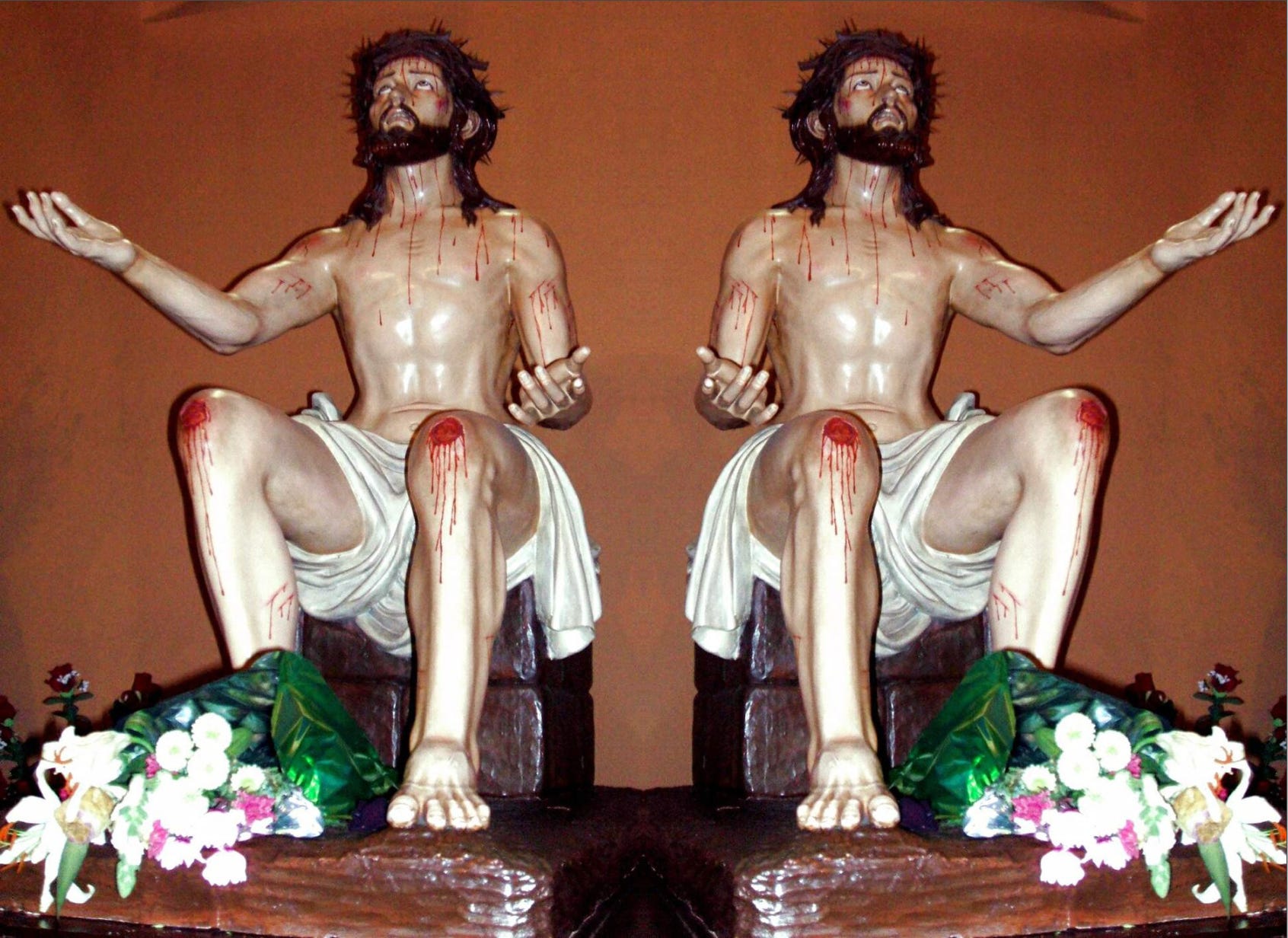
“You should talk to Sandra,” someone had told me, “if you really want to understand how it all got this way. She knows something about it.” So, “Sandra,” I said one day, as Jesus watched from the nightstand, as he clutched his own heart, wrapped in thorns and wreathed in flames, “what was it like?” “You know? Being in las FARC.”
***
The bomb itself was not a sophisticated device, according to a Caracol Radio report. “Just black powder inside galvanized PVC tubes,” which one of the improvised-explosive-device (IED) experts later described as “four sections and a syringe with liquid that upon contact would make the whole thing explode.” Another expert, however, pointed out that “it must have taken the terrorist a long time” to make it. “Time to design it, time to think it up. Time to make it so hard for authorities to deactivate.”
Time, and time, and black powder, and time.
Simple.
A man in a room putting pencil to paper and powder to pipe.
Not so simple.
Because to take the risk and to take the time, one must really want to make a bomb, which, in the making, wants only to take the maker’s life.
A man screwing hacksaw fangs into a starving lion’s mouth while he sleeps.
Not simple at all.
Because it is a thousand-hours-of-staring bomb. It is made of living room pacing and beer-round discussions. “Should we stay and explain it? Should we leave a note? If not a note, then what?”
***
Sandra had had trouble at home since she was a little girl. “Uy, uy, sí,” she told me. “Desde chiquita.” Even before her mother fell in love with one of Sandra’s classmates and decided that all that mattered in life was being loved by this adolescent boy. “She went crazy for him, cried all day, all night. If he didn’t come by, if he didn’t say this, say that. Didn’t kiss her, didn’t love her. You know?” Sandra’s mother would stop crying, then she would start up again, for days, for weeks. “My mother.” Sandra looked away and shook her head. “She said a woman without a man was not a woman at all, and barely anything at that. So she begged him to stay, promised him the heavens and the earth and everything between, if only he would stay.” For days, for weeks, until he finally moved in, and Sandra moved out.
It’s hard to picture. Sandra’s mother in a black shawl. Maybe an apron, or a brown jacket. Sandra’s mother under thick wool blankets with her hands reaching out for this boy. “No, the black shawl was right. But mostly a sweater. It’s a little cold out there.” A farmer with callouses on her hands, a few cows and chickens out back. “You know, a garden. Little of this, little of that.” The same, I imagine, as Sandra might have been, had things turned out a little different. “Oh yeah, I mean, maybe not. But, yeah. Things are easier out there, much harder in this city.”
“Easier how?” At twenty-seven, I had lived in six different countries, ten different cities, and sixteen cheap apartments, but had never wanted to feel “at home” anywhere but in Bogotá.
“Oh, you know.” She leaned back. “There’s always something to eat out there, you know?” I don’t. “Out there, you never starve.”
I tried to guess her age, wondered what bombing or which peace process was happening when she ran away from home. “And here you do?”
“Here?”—she raised both eyebrows—“oh yeah. Every day.” She put down her phone and looked out the window at the whirling rush of a hungry city. “Out there … it’s something else that gets you.”
***
Doña Elvia’s eyes are cast downward as she waits for the specialist, holding up the PVC pipe collar with her left hand. The tighter that black powder is packed, the heavier the bomb becomes, and I wonder if the edge of the plastic pipe cut into her skin. If it felt like the bomb itself is trying to make her kneel before the god of dynamite. It is likely that there is another god beneath the PVC collar bomb, Jesus hanging from a little gold crucifix like the one around most Colombians’ necks. Same as the one the bomb maker was likely wearing too.
It is hard to tell much from the images of that moment. A woman in a thick brown coat, white earrings, and short, curly hair dyed a reddish brown. Though one thing is clear: she looks tired and afraid. Every article will mention it. Pipe wrapped around her neck, tape wrapped around the pipe, and a look that says, before she actually said it, Why? To Officer López, when he finally arrived at the scene, “Why did they do this to me? I haven’t done a thing to anyone.”
It doesn’t take me too long to realize how much she reminds me of my mother.
Six hours left.
***
In 2003, about three months before I graduated from Catholic high school, at eight thirty-five one evening a FARC-made bomb went off in a private club in Bogotá and thirty-five people were killed. It was loud enough that I heard it from blocks away in my bedroom, and we spent the rest of the night watching the television as neighbors dragged mattresses onto adjacent rooftops and urged the people left inside the club to jump: “Jump! Jump!” From a burning building. “Come on, you can do it! Let’s go!” A year prior, 119 civilian men, women, and children had been burned alive inside a church where they were hiding while the paramilitary forces faced off against the FARC for this strategically located town. In 2010, in a town called El Charco, a boy of only eleven was approached by a man in uniform. “Take this to the police station over there,” he told the boy, and gave him a thousand pesos, roughly fifty cents, to make the delivery. The boy used to do this all the time: he was poor, and for a fee, he would place whatever you liked, light or heavy, on his back or atop his head, and carry it wherever you asked. As soon as the boy set foot inside the police station, however, the package that was not a package but a bomb, exploded. Nine civilians and three officers were injured, and all that was left of the boy were two severed legs beneath the rubble, and, according to an article in El Tiempo, when a neighbor found them in a pile of broken tile and shattered brick, he looked up and yelled, “They blew up a kid!”
“This is not a war,” my mother once said while we watched the news. “It’s a suicide.”
***
All the accounts mention how nervous and agitated Doña Elvia appeared. In fact, an article that I can no longer find but distinctly remember mentioned that amid instructions and threats, the cavernous, nasal voice on the tape suggested giving her “some tranquilizers” because “this sort of thing is hard on the nerves.”
***
Running away takes practice too, and Sandra practiced. She stayed with aunts, cousins, friends. For a night, for a weekend, for a month. “But I always did go back. Check in on mi mamá. Make sure she was all right.”
Sandra has an open face, she’s quick on her feet, and once, when a man tried to beat her, she took a kitchen knife and swung it so hard she sliced through his leather jacket. “Didn’t cut him bad, but that was the last time he tried it.” There is both an edge and a bluntness to her—sickle, hammer, and nerve—and “she is very smart,” my mother told me once. “Es muy obvio.” And I knew by the tone of her voice that what she meant was, Be careful.
“You kept on running away, then?”
“Yes.”
“For how long?”
“Years.”
“And then?”
“Well, that you already know.”
But I didn’t, not really.
“These guys,” she said, looking absentmindedly at her phone, “they sometimes came around to our town. With their guns, and the camo, and the boots. Good guys, buena gente, though, you know?” Silence. “Always very nice to me,” she said, and waited for me to speak.
Finally, I managed, “Nice how?”
“Oh, you know,” Sandra said. “They would show me their guns and teach me how to shoot them, and this guy—big, nice guy, a commander—he told me, ‘If you ever wanna come and join us, you are more than welcome.’ ”
We sat quietly in the dark for a moment. Silence can be anything, mean anything, mean nothing too. After she left the FARC, she laid brick at construction sites and put herself through school, traded fatigues for hospital scrubs. I like her: she is smart and funny, good in a crisis, and good to her patients. She never put up with the men who tried to take a swing at her, and after all that happened, she still went back home and still cares for her elderly mother. And yet, and yet.
“And that was it?”
Sandra nodded. “One day I’d had enough. I didn’t say goodbye. I just left.”
***
Jairo López had planned to stay home that day, to take care of his wife and five-day-old son, according an El Espectador article written by David Leonardo Carranza Muñoz. The twenty-eight-year-old Jairo Hernando López, who, by eight thirty that morning, was already carefully sliding his saw across the PVC casing around Doña Elvia’s neck.
In the distance, officers held back her husband as he, according to a May 19, 2000, El Tiempo article, “[attempted] to go up to her, and embrace her.”
He was sixty-seven years old, and it was probably very easy to hold him back. One hand on his chest and a few stern words. “Please wait here. Please let us work. We are doing all we can. Not long now.” Still, I wonder. Sixty-seven years old, a two-and-a-quarter-hectare farm, six cows, a dozen chickens, two children, a whole lifetime married to this woman who was trembling now on the side of the road. Their whole life together, and hers, running out the clock.
Perhaps it was hard to hold him back after all.
Five hours left.
***
“Oh, no, no, Lina. It’s not like that at all.” Sandra shook her head and scoffed when I mentioned rape. “Not at all.”
She didn’t use the word, didn’t say anything else about it, except “If you could see.” She tilted her head and placed a hand over her heart, like, Oh my! And, You wouldn’t believe. “They gave us the nicest underwear,” she said.
And it took me a minute to really hear it. “I’m sorry, what?”
“Oh yeah.” She raised her eyebrows and nodded slowly. “The nicest.”
But her reply clarified nothing. “What do you mean? Like … how? Why?”
“It was all part of it, you see? You go in like a nun, and they give you everything—food, boots, ammunition, underwear. And they made sure it was the real nice kind, the ones from, um … from the catalogues. Do you know the ones?”
“Like …” I tilted my head and straightened my spine. “Like lingerie?”
“Yes!” Sandra lit up. “That’s it, lingerie. Really nice too.” She ran her fingers over the collar of her nurse’s uniform. “Silky and frilly. But …”—she tilted her head once more and I understood instantly, Here’s the catch—“it was only ever one-pieces.”
“What … ?”
“So we could bathe in them.”
“So …” I tried again, “like a bathing suit.”
“Yes.”
“So you wouldn’t ever have to be completely exposed?”
“Exactly.”
I tried to picture it. A dozen women under improvised showerheads, rifles, clothes, and boots in neat piles beside a tree, while the jungle grows and groans around them. A handful of their peers patrolling the area while someone in a tent tries to tune an AM radio to find out if Falcao will be able to play for the World Cup qualifiers: Please, God, let him be all right, let him play, make us proud, give them hell. The women shiver under cold water as they slip soap under fake-silk frills like grease between gears, pulling on the fronts of their guerilla-issued lingerie and trying to catch water between their breasts. “Still,” Sandra insisted, “it was the nice kind. You’d be surprised.”
“But … why?”
Then she drew two squares in the darkness. “The men, see? They were over here”—she motioned to her left—“and the women, over here”—then to her right. And I understood this too. Andrea’s skirt, shower curtains, closed doors, and flak jackets. “It wasn’t like that at all, Lina.” She repeated this until she saw me nod. “And besides, that sort of relationship, it was forbidden.”
***
Within an hour of his arrival, as he stared into the ticking heart of an IED, Officer Jairo López decided that the mechanism was not too complicated after all, and he begun to disassemble it himself.
“Don’t you worry, mi señora,” he told Doña Elvia as he maneuvered through wires and needles and pockets of chemicals longing to burst, and spill, and suck in all the air in a roaring gust of noise and fire. “Stay very calm.” In his shirtsleeves—“muy tranquila”—because, he explained to the other officers, he thought the blast-suit would only make her more nervous. And isn’t this hard enough? “Almost there.” Wearing nothing but cotton and skin in the court of the god of dynamite and death. “Won’t be long now.” Snipping patiently, wire after wire, like the tiny roots of tiny trees growing from black-powder dirt. Like he was trying to keep a miniature forest of untamed fire from sprouting around Doña Elvia’s neck. “Stay very calm,” he repeated. “Because in a few minutes I’ll be done, and we’ll go get some lunch together. In fact, I’m buying.”
But Doña Elvia was having trouble remaining calm. Too much time had passed, and she may have found herself staring up as the sun slid and slithered across the open sky, and she repeated herself to Officer López, “They said they had a remote control. They said it was on a timer. They said …” Only a few strings were left holding up the sky, only a few wires holding her hostage. “They said they would know, if we called … They said …” Did she then glance out beyond the road, did she turn her neck as much as the PVC and Officer López would allow—Please, stay very still—did she see one of them in the crowd?
Animal memory bucking in her blood, begging her to stop waiting, to take it off herself, to shake it off like mud. To hiss, to howl, to sprint into the woods. Get it off, get it off, get it off! Too much time had elapsed, and this may have been all she could do to keep herself from thrashing and howling and chewing her way out of that PVC trap. Did she regret refusing to pay such a paltry sum? Did she lock eyes with the man who may or may not have been in her home that morning, who may or may not have built a bomb on his kitchen table the night before?
She looks at Officer López as he snips another cable, and says, “You won’t let me die here, will you?”
Four hours left.
***
Sandra promised me she’d never seen combat, though I never asked.
“I swear it,” she said, unprompted. “We were so lucky.” Interrupting herself, “I thank God and the holy Virgin Mary every day for it,” interrupting her interruption, “I don’t know how I could live with myself if I had.”
Again and again until finally I asked, “Why did you leave?”
Silence.
“What do you mean?” Sandra asked.
“Well, they took care of everything, gave you everything. Lingerie, boots. And no combat. Why leave?”
“Oh.” She pursed her lips and looked out the window, a partial moon in a partially covered sky. “You know.” She said, “Things were getting hard. Harder.” She looked down at her phone. “I was getting tired of it all, you know?”
I didn’t, but I nodded all the same.
“Well, the rule where you couldn’t date, I mean … right?”
I nodded again. “Sure.”
“But you can’t just leave.” Her features became harder as she drew in a breath. “One can’t just pick up and go.”
“Wouldn’t want deserters,” I said, leaning back against the wall. Saints above me, the image of the Virgin to my side, a cross around Sandra’s neck and, on the mantel, Jesus with his sacred heart hanging out of his chest like a scarlet kite caught on a meat hook. Less than thin-skinned, worse than skinless. This one precise image of the crucified god upon which José Manuel Marroquín—the poet-president of Colombia—set his eyes and thought, Ah, yes! After years of war, decades of conflict. Yes, yes, that’ll do. As he declared Colombia the country of the Sacred Heart of Jesus, certain that would be enough. This’ll finally heal us.
“Right.” Sandra nodded and seemed to grit her teeth. “So obviously I couldn’t. But …” She looked away and appeared to be lost in memory before finishing her sentence. “There was this boy, see? He was in love with me. He helped me get out. Sweet boy.”
“But,” I tried again, “why exactly did you leave?”
She shook her head and touched her lips, something between a shushing silence and blowing a kiss. “God knows,” she said. “He knew the risks.”
“The risks?” I leaned in. “What do you mean?”
Another boy, maybe a sweet boy too—Sandra didn’t remember—got caught trying to escape a few weeks before Sandra made a run for it too. “Young, though,” she recalled. “The unlucky sort”—she furrowed her brow—“but nice.”
She said she did not know him well, then she said it again, and again, same as “I did not see combat, thank God. We were so lucky” and “I barely knew him, really.” I swear. But “he was nice.” Nice and young and eager to leave, for who knows where and who knows why, but then they caught him and decided to make an example of him.
“Tied him to a tree by the neck with barbed wire,” Sandra said, looking out the window and resting her chin on her hand, as I imagined a barbed-wire leash and a man at the end of it, brought down to his knees before the god of failed revolutions.
“He couldn’t stand upright, see? Tied there at the base, you understand? Anyway, he died, and this boy had to bury him.”
“The sweet boy?”
“Yes.”
Pause.
Sandra did not explain in detail, and I did not ask.
A man stripped down to his underwear, kneeling beside the thick trunk of a ceiba tree while rusty spikes dug into his neck, asphyxia blue and infection yellow.
“The boy who died, I think he knew him better than I had, or maybe not. It was hard for him to bury that boy anyway—and how he loved me. He wrote me these letters, said all these things, if you could see them. You wouldn’t believe. Anyway, it was time to go and he arranged it all. Every bit.”
“Just like that?”
“Just like that.”
“And then you left.”
“Didn’t say goodbye.”
***
“Not a chance,” Officer Jairo López told Doña Elvia, while taking the bomb apart piece by piece. “From this one, you and me both are getting out scot-free.” He was breathing very carefully and digging expertly through cables and plastic.
Did he think of his newborn son back home?
Perhaps not; this was his job.
Three hours left.
***
In 2013, I moved to China, the farthest point from Bogotá according to the inflatable map in my childhood bedroom.
“First one in our family,” my mother said proudly, “to cross the Pacific.”
Twenty-four hours from home in either direction and two hours south of Shanghai. Into a city in the throes of mandatory urbanization, into a fourteenth-floor apartment with walls made spongy by the humidity, and into a room with a balcony where I could look out at a metropolis made up of gleaming buildings and half-demolished houses.
Nets full of frogs, cages full of birds, and packs of stray dogs running wild through the alleys.
In the summer, I watched pixelated fútbol games, yelling, “Go, James! Go! Go!” While a red alarm clock flashed 2 A.M., “You show ’em, go get ’em!” Until my neighbors started leaving notes on my door that I could not read but understood perfectly. In the winter, I tuned in to Colombian radio stations through a virtual-private-network connection, and half listened to talk of the latest peace negotiations: “This time, maybe. Who knows?” And “Come on, be serious. Nothing’ll come of it.” I used to get up very early and sit on my balcony watching the smoke of burning crops drift in from the fields, into the city, through my open window and into my lungs like flock of crows settling on loose powerlines.
I read a lot and very little. The same three books, the same five emails—again and again and again. One, in particular, from my mother in which she told me she was so proud of me, and so tired too. Of the gods of cancer and cruelty. Of how far away she’d sent her children, and how close she’d kept herself. And then, This miserable city, this miserable-miserable city. “It would be nice,” she wrote, “if you were at least in the same hemisphere, close to the same continent. At least. We don’t want you to be quite so alone.”
Black smoke and a pale Chinese moon. I climb atop a wobbly plastic chair and carefully stepped over the railing. Bare heels on the edge, hanging above a fourteen-floor drop, over a new miserable city I already loved, trying to decide what to keep and what to cut.
***
Doña Elvia Cortés Gil de Pachón is famous now. Not as famous as Lucho Herrera, Juan Pablo Montoya, Sofía Vergara, or Shakira. But famous nonetheless, in Colombia and in some human rights circles too. There are a movie and a whole episode in a CSI-type show with fast graphics, whooshing sounds, and reenactments.
Though I can’t really get myself to watch either one.
By Monday at one o’clock in the afternoon, two hours before the set deadline, the bomb exploded. Doña Elvia was dead, a first-time father was bleeding out, and Colonel Santiago Roa Millán had declared that this was the FARC’s doing.
“All we could do was try to keep up her spirits,” he said. “Tell her that we were doing everything possible … Then suddenly, after so many prayers,” the explosion. The following day the peace talks were suspended. “The rest,” the colonel said, “you already know.” Though I’m not sure we do.
From El Caguán, the president declared that “those who are violent,” los violentos, “… have placed a collar of dynamite, not merely around the neck of Doña Elvia—whose death we grieve in our hearts today—but around the hope of all Colombians.”
Two days later, she was laid to rest. There was a massive ceremony and an equally impressive procession. Men and women dressed in black, marching to the beat of their fists striking their chests, again, and again, “mea culpa, mea culpa,” as they slowly made their way toward a chapel declared holy by the pope himself after the Virgin made a brief appearance there. On the very same day, an anonymous call was made to a nearby Catholic high school. Tucked inside the building like a defective gene, the voice declared, was a bomb. An article titled “A Sum of Errors”[1] reported that the children ran through the school gates crying out that they did not want bombs strapped around their necks, while teachers tried to herd them toward a park named after the pope who had declared their city holy and their ground sacred.
Within days of Doña Elvia’s death, the local FARC commander issued a press release stating that they had not been responsible after all. They said it was a local band of extortionists—“those who are violent!” Nothing at all to do with the armed group.
Officer Jairo López lost his right hand and left arm, and then, on the way to the hospital, his family lost him, too, to blood loss and shock. Three of his coworkers were also severely injured in the blast. Fingers, hands, male members, and melting skin. “Anything,” a man at an intersection once told me, “that isn’t nailed down gets blown off,” as he stretched out greased-covered hands with fingers burned off near the knuckles, into which I deposited a fistful of hundred-peso coins.
Only one man, a former farmhand in Doña Elvia’s field and a member of a gang of local extortionists known as the Rabbits, was tried and sentenced to more than twenty years in prison. A country at war with itself tends toward this sort of justice. And though his account corroborated the FARC’s lack of involvement, not everyone was convinced, and images of Doña Elvia looking away from the camera and tugging on the PVC pipe collar would be circulated during the 2016 peace negotiations to remind Colombians why no deal that the devil strikes is ever fair. Officer López’s family would never quite believe the official story. Those opposing the 2016 peace negotiations chanted, “No peace without justice! Think of the victims, think of the dead!” In every rally, at every election, while supporters gathered just as faithfully and wrote that it was time to officially join the political discourse and trade the boots and fatigues for shirts and ties. “Think of the living! Think of us all!”
“Tomorrow,” one commenter on a newspaper forum wrote, “are we all going to be different when this piece of paper gets signed? Are we suddenly going to be peaceful and safe? And who are those people going become, are we even going to know them?”
In China, I imagined a country picking itself out of a police lineup. On a balcony, I remembered an Ecuadorian man who dismissed Colombian violence by saying, “It’s nothing compared to what we do here now; you guys are amateurs,” and for a second, I wanted to bring up Doña Elvia. Because I did not like this man, and because everything he said was critical of my country, and I wanted to prove him wrong. I wanted to invoke Doña Elvia’s name like a holy footnote, like a PVC trump card. Because it was the worst thing I could think of, and then suddenly I was the worst thing I could think of too. “We are number one now. Maybe in the eighties and the nineties, it was Colombia,” the man said, “but not anymore.” Go, violence! Go! Our violence, go show ’em, go get ’em! We are number one!
The mist clearing, Jesus pulling back his robes like a girl inches up her skirt. Barbed-wire crowns, and a heart hanging out of a god’s chest like the lure of an angler fish. Still-warm milk, black powder, and rubble. Will we even know the bomb makers from the bombed? What do we look like from afar? Will the country forgive those who left, those who stayed? In the city, in the country, in the countryside, in the jungle, at arm’s length? What next?
A hand around a PVC pipe, around a neck, around a package that is not a package, while we try to hold together a country built atop secondhand Bethlehems, Palestines, and homes called Hope. As we try to remember Doña Elvia and forget what was done to her.
[1] In 2017, a rural newspaper called Mirando El Campo published an article cataloging and condemning the errors made in the case of “El Collar Bomba.” Its opening line read, “Elvia Cortés, a name that will never be forgotten.” Nine years later, the webpage is defunct, and no trace of the article remains—save for the PDF I downloaded on October 9, 2017, when, in a burst of fevered rage, I wrote this essay. The article aligns with reputable national reporting in nearly every respect but one: I can find no other corroboration of this alleged school bomb threat. I’m left to wonder about a country so steeped in tragedy that it fails to record children running through the streets in terror, clutching their own necks. I wonder, too, about memory, embellishment, and the impulse to make a point greater than the facts allow.
Lina Maria Ferreira Cabeza-Vanegas is the author of a short-story collection, Drown Sever Sing, and a hybrid essay collection, Don’t Come Back. She has been published widely in journals and magazines, such as the Los Angeles Review of Books, Harper’s, and Guernica. She is an assistant professor at the University of Chicago.