

Rotten Dot Com
“Rotten.com was a haunted arcade,” Dena Yago remembers, “dispensing trauma in gumball-machine doses straight to kids with dial-up, who chewed on images never meant for their half-formed stomachs.”

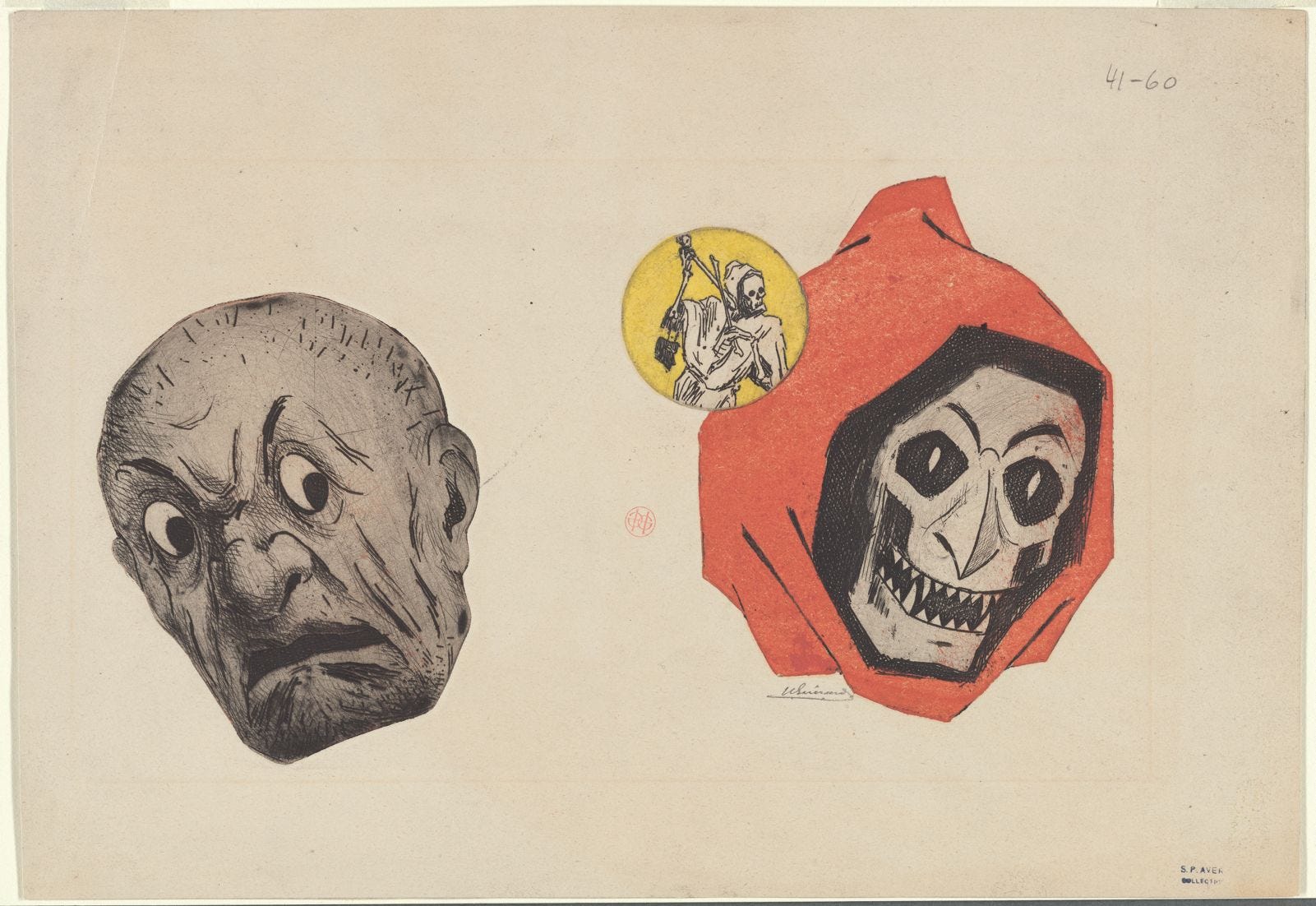
“Wanna see a dead body?” Milo asks from the back seat. The 5 is a white blade under the Valley sun, everything bleached flat, overexposed as we fly toward Fry’s Electronics. It’s 1999. The Acura’s sweating leather sticks to my thighs. My skin feels amphibian, a tween-age Geico gecko blinking too hard, raw in the new light of too much consciousness.
Even at eleven, Milo likes to pull out provocations sourced from some dark aquifer on the internet not yet known to me. Unlike Milo, I don’t have a PC in my bedroom. But we’re on our way to fix that.
Now Milo pivots, unzipping his backpack like a schoolyard dealer to flash two CD jewel cases. Rob Zombie’s Hellbilly Deluxe (1998): an X carved into his gristly forehead flesh, chrome flames across the plastic. Busta Rhymes’s Extinction Level Event (1998): a world on fire, his mouth mid-detonation. “Which one?” he asks.
I don’t answer, reluctant to admit I know neither. Noah, my brother, at the wheel, picks Busta in the rearview.
“If you want it, let me hear you say it (gimme some more),” Busta belts.
I, too, am eleven. A child of a recent bicoastal divorce, spending the summer in the Pacific Palisades, being driven to Fry’s to assemble my first desktop PC—my twenty-three-year-old brother’s gift in the key of fraternal benevolence, pedagogical duty, and Californian techno-optimism. A deal struck with my dad: if we can build it, I can keep it in my room.
Milo—my surf-tanned, platinum-blond, Point Dume–living, feral best friend with an Insane Clown Posse fixation and a household parrot that mimics his mother’s laugh—is along for the ride. He’s beautiful and hectic. I want to live in his house. I want to live in his brain, his skin. I’m high on his confidence the way only a young girl without much of her own can be. So yes, sure: I want to see a dead body.
We pull into the parking lot. Fry’s is a postmodern cathedral dressed up as a computer store, its facade impaled by a crashed UFO, the aisles flanked by gargantuan fiberglass ants—making us feel like we are in Honey, I Shrunk the Kids (1989) but shot in Valley glare, catching the reflecting sun of an out-of-reach Hollywood. We move through motherboards, mice, and surge protectors, with Busta—“Gimme some more”—still looping in my head.
Back home, in my specifically Betsey Johnson pink-and-green-inspired bedroom, we drink sun tea, clear Beanie Babies from the desk. We slot in the motherboard, attach the fan. Noah, our IT magus, presides. We wait for the Windows start-up chime to ring out. The tower blinks alive. It’s wholesome enough, with something even like holiness in the air. The light shifts. The internet opens its putrid maw. We are off to see the bodies.
We riffle through the mail pail and find an AOL-installation CD. The dial-up crackles as sound ricochets off the gates of the internet underworld. A rush of cold air lifts the muslin drapes and raises the downy hair on our too-tanned summertime prepubescent flesh.
Milo two-finger types, one key at a time: w-w-w-.-r-o-t-t-e-n-.-c-o-m.
Like everyone else I knew who’d found their way onto the site, he’d first seen Rotten on a friend’s family’s desktop. The name was passed around in hushed tones, traded as contraband on AOL Instant Messenger (AIM), slid across classroom desks in folded notes.
It felt like discovering an older sibling’s porn stash, except more raw, more despicable, less human. It felt illegal. Like the childhood certainty, fed by the inevitability of horror lurking at the edge of fairy-tale pages, that you’d be struck by lightning or get bitten by a shark or end up in jail. Who knew? Maybe in life I could end up killing a man or stealing a car. Rotten was a key you turned that locked a door behind you.
The home page was plainer than it should have been: white background, blue underlined hyperlinks laid out with the punishing utility of a DMV intranet. The soft white underbelly of the Net, eviscerated for all to see. Underneath, a subtitle that had the ring of a warning read aloud by a neck-bearded Charon, oar in hand, ready to ferry us across the Styx: “Rotten dot com collects images and information from many sources to present the viewer with a truly unpleasant experience.” Then, below, an inventory of links with one-line captions. “Maggoted: Why does a living man have this condition?” “Meat Grinder II: Very unfortunate kitchen mishap.” The T-shirts, one of which a kid would eventually show up to school in, said it more plainly: “PURE EVIL SINCE 1996. Flush please.” The whole effect added up to a GeoCities-era HTML ledger cataloguing unspeakable horrors in the register of a blasé librarian. Served directly to our oatmeal-mush prefrontal cortexes were botched suicides, severed limbs, an unrecognizably swollen corpse rumored to be that of Chris Farley. Another obese dead body on a sidewalk, captioned “splat.” Patently offensive material, engineered to scandalize adults yet magnetically consumed by minors. This wasn’t meant for us. We weren’t supposed to be there, which is why we weren’t going anywhere.
***
Rotten.com had been launched three years prior, in 1996, by a former Apple and Netscape engineer who went by Soylent; his real name, aptly, was Thomas E. Dell. The website operated under the umbrella of Soylent Communications, under which orbited a portfolio of the obscene: the Daily Rotten, the Rotten Library, Bonsai Kitten—early traffic farms of abjection, some with political underpinnings. Rotten itself was a free-speech dare, a provocation in the shadow of the 1996 Communications Decency Act (CDA), which attempted to criminalize “indecent” or “patently offensive” online material that was accessible to minors.
In the American tradition of “protecting minors” as a cover for culturally right-leaning restrictions, the CDA smuggled in a broad censorship regime. Civil liberties groups like the Electronic Frontier Foundation and the American Civil Liberties Union argued that the act would criminalize vast expanses of the internet. It sought to sweep up everything from university servers to sex-ed resources and online sex work in an ongoing effort that resurfaced twenty years later, in 2018, with FOSTA-SESTA (the Fight Online Sex Trafficking Act and the Stop Enabling Sex Traffickers Act, respectively), two pieces of legislation that collapsed entire swaths of the Web. Craigslist personals went dark overnight, and sex workers were forced off the relative safety of platforms like Backpage or Rentboy and into more precarious spaces both across dark webs and on the street. Even sites like OnlyFans reshaped themselves in FOSTA-SESTA’s shadow, and were forced, by payment processors newly skittish in its wake, into briefly announcing a 2021 ban on sexually explicit content—before reversing course after a creator outcry.
Rotten’s founders explicitly framed the site as a challenge to this moral order. In a manifesto, titled “Words,” that he posted to the site, Soylent argued that “censorship of the Internet is impractical, unethical, and wrong,” and that to censor Rotten was to censor “medical texts, history texts, evidence rooms, courtrooms, art museums, libraries.” CDA was state-backed censorship cloaked in the language of protecting children, and the wager was to redraw the boundaries of the internet so that “indecent” and “illegal” became indistinguishable. Rotten’s strategy was to test that line by posting only what was technically permissible: public-domain, medical, or news-sourced material that was nonetheless grotesque or taboo. It focused on the distasteful but not the prosecutable. Only one year later, the Supreme Court struck the CDA’s core down in Reno v. ACLU (1997).
And yet the golem persisted. Rotten.com carried on as a grotesque monument to the profane. It was a haunted arcade, dispensing trauma in gumball-machine doses straight to kids with dial-up, who chewed on images never meant for their half-formed stomachs.
***
At summer’s end I powered down my beige beauty of a desktop, kissed the California glow goodbye, and headed back to my mom’s house in Macon, Georgia. After school I parked myself in the home office, dialed into the AOL mainframe, and pinged “squealinglilpiggy,” Milo, on AIM. Let the Rottening begin.
Squealinglilpiggy and I had a routine. AIM chat rooms were organized by category in public directories—”Romance,” “Politics,” “Religion & Beliefs”—and you could drop into any of them. Young Christians was a regular of ours. A Jew ejected from California and deposited among corn-fed Friday Night Lights–style Christians following my parents’ divorce, I found the room was one of the few places I could work out my alienation and theological rage with an audience.
We had recently stumbled across a particularly rotten image: a middle-aged man in soiled underwear and a leather collar fastened to his neck in a dank basement. We set the scene in our AIM chat first. I would be the gimp, he the captor. We started small. I entered the room in a normal register—a lonely kid who was curious about God—and let the regulars welcome me. I asked questions about prayer. I said I was scared. I said I wanted to be saved. Only slowly, across forty minutes or an hour, did the story darken: I was sitting in my own filth. I had been down here for a long time. I was trying to find God. I needed to be saved, from my cage and from my damned mortal coil. I typed with bloody fingers from the dog crate I’d gnawed my way out of, begging for redemption. We were not fooling anyone. But the chat room kept responding, kept offering to pray for me. Squealinglilpiggy timed his entrance for maximum devastation: he’d log on as we reached the moment of salvation, reveal my deceit, and rain down threats. “I’ll stuff you like a Christmas ham,” he told them, “blind you with a crucifix, baptize you in shit.” The room combusted in something like righteous outrage. We logged off and printed the transcript.
Our gimp-captor scripts felt like private inventions, but of course they weren’t. We had absorbed a whole grammar of trolling by osmosis. By the early aughts, people were passing around LemonParty.org as a bait-and-switch prank link: it was a web page consisting of a video of three normal-looking, horny elderly men engaged in oral sex. There was also Tubgirl, shorthand for the absolute worst thing you could be tricked into clicking on, and it spread like a dare: a jpeg of a naked woman in a bathtub shitting a fountain of orange-brown diarrhea over her own face. Groups like the Hick Crew had already made a practice of spamming Christian chat rooms with goatse.cx—a legendary image of Kirk Johnson “spreading hole.” They, and we, performed antagonism, jeering at the gullible.
I kept our AIM printouts in a plastic sleeve slipped under my mattress, shamefully, gleefully. The pages are gone now—likely shredded in a panic the day I imagined my psychoanalyst mother reading them—but the memories remain. And it wasn’t just us: plenty of millennials I know once owned similar receipts of deviance. We spent hours toggling between Rotten.com’s static carnage and live AIM rooms. Rotten’s images bled straight into our scripts. Corpses were reanimated as characters, the gore became a prop in our rehearsal of humiliation, mercy, and desire. The internet was a space of total freedom and zero accountability.
For a tween in Macon, where nonconforming sexuality or gender presentation was shunted to the shadows, the Rotten-to-AIM pipeline was an education and a theater-scape that the town could not provide. Or rather, the town did provide it—in the style of the Southern Gothic trauma of closeted sexuality and worse—but the internet made it feel safe. One day I would be the gimp; another day, I would type “A/S/L” and send a photo of Adriana Lima in exchange for a stranger’s dick pic, only to be called out—“That’s not you, that’s a Guess model!”—at which point I’d confess to being a mouth-breathing Kinko’s employee who needed punishment, then hard shut-down the tower and pour myself a glass of ice-cold orange juice.
In clinical language, children and adolescents use play to model risky acts from a distance—to rehearse transgression in environments without bodily consequences. As D. W. Winnicott puts it in Playing and Reality (1971), “It is in playing and only in playing that the individual child or adult is able to be creative and to use the whole personality.” Even domination and submission—gimp and captor—are, as the analyst Jessica Benjamin has argued, a process that ensnares both parties in bonds of complicity, structured by the failed work of mutual recognition.
The CDA imagined children as innocents to be shielded; in practice, children were inventing indecency themselves and broadcasting it into online rooms filled with strangers. Probably many eleven-year-olds pretending to be twenty-year-olds had a suspicion that the person they were chatting with was actually a forty-year-old in a basement somewhere. AIM chat rooms were not a threat to childhood but rather its crucible: places where one could sit with the abject until it lost its sting, where horror became malleable, and where nascent queerness and kink first found public expression under the protective guise of trolling.
When Milo and I reunited back in Southern California and took the scenes offline, the results rerouted back into the realm of an oddly tender childplay. We staged tableaux with Beanie Babies and filmed them on a Hi8: Rainbow Caterpillar chose public seppuku at her high school pep rally rather than face single motherhood. Princess Diana Bear, the mean girl, spent weeks tormenting her shut-in target, American Bear. American Bear eventually came back as a Columbine-style trench-coat shooter.
***
The pipeline from Rotten to AIM ran alongside other channels and bled into them. eBaum’s World, for example: the proto-meme aggregator that metastasized into the feed logics of FAIL Blog and 9GAG. Pirated-file-sharing services like LimeWire, Napster, and Gnutella opened direct lines to every imaginable form of flesh, whether you sought it or not: the first time I encountered scatological porn was while trying to download Liz Phair’s Whitechocolatespaceegg (1998). And there was the recursive way that new media scavenged the old. Early Rotten seed images were ripped from TV broadcast and print—Tupac’s autopsy, Columbine’s cafeteria stills—proving the maxim that the first wave of content for a new technological medium comes from the one immediately preceding it.
Meanwhile, the offline world was performing its own grotesqueries. If Rotten was the public archive and AIM the rehearsal room, then the national stage was set to feel real, real bad. The year of my Fry’s desktop, 1999, gave us Columbine and Woodstock ’99. Columbine: the massacre that blurred instantly into imagery that was shot through CCTV and looped endlessly, then was archived and resurfaced online. Woodstock ’99 was its inverted image: full-grown white-male grievances amplified, monetized, and platformed on a corporate-sponsored stage, self-immolating in real time and broadcast live on MTV, the echoes of a proverbial wakakaka echoing through the bucolic Hudson Valley. Here was the same alchemical rot of rage and grievance playing out at once as private theater, Clearnet archive, and mainstream spectacle. It was also one of the last moments of true monoculture—a moment when everyone could still watch the same flames together, on the same screen, at the same time. Survivor and American Idol were pulling in the same direction: appointment television as a collective ritual, the country gathered around the same broadcast. Today that ritual is gone. A public spectacle of grievance—a war, a riot, a killing—no longer happens to a national audience. It happens across feeds, in fragments, already metabolized by the algorithm before anyone sees it whole.
***
By that crepuscular dawn of the turning century, a younger generation’s pumps were primed to dissociate from these horrors. Rotten famously reposted the images of human beings hurling themselves from the Twin Towers in a file called “swandive.jpg.” Two years later, the images leaked from Abu Ghraib made the circuit explicit with photographs of hooded Iraqi prisoners wired to electrodes, stacked in pyramids, and of soldiers posing with grins and thumbs-ups. It was Rotten courtesy of the American military.
In Regarding the Pain of Others (2003), Susan Sontag states the obvious: that digesting atrocious images repeatedly numbs us to them. By 2004, when photographs of the abuse at Abu Ghraib prison first surfaced, my group of online youths had been rehearsing atrocity as play for years. We had not only seen such images; we had simulated them by inhabiting the roles of both tormentor and tormented in AIM chat rooms. The desensitization was not only visual but embodied, a muscle memory knotted together with the libidinal impulse of early sexuality—shame, arousal, cruelty, recognition. What mattered wasn’t so much the image itself but how it moved. Its value lay in its circulation: whom you could shock, how fast the chat room would combust, how far something would travel before it came back to you like a bad penny. Like any horror gag, the corpse is just a prop until it reanimates. Only then do you run. We spread each image like a virus, multiplying it through inboxes and buddy lists, a chain letter from hell that we kept passing along.
Images stopped being evidence of anything. They became raw material to restage as printouts, as forwarded emails, as props for whatever script we were running. Their origin didn’t matter as much as the charge they carried. Not “What does this image mean?” but “What does this do to me?” The images moved through our bodies as sensations—horror and arousal, laughter and shame blurring together—one minute in private in my pink-and-green room, the next performed in front of strangers (from the safety of said room). Passing them around bound us into a group of very online kids who learned early that atrocity could be terrifying, hilarious, disgusting, a smidge horny, and, above all, something you could play with.
In early 2001, Rotten was investigated by Scotland Yard and the FBI over an image of alleged human cannibalism, and was threatened simultaneously by Germany’s family ministry and a rolling list of corporate cease-and-desists, including from Coca-Cola, Pillsbury, and Burlington Coat Factory. Soylent’s defense, as invoked in Miller v. California (1973), the Supreme Court’s obscenity test, was that Rotten’s images carried “literary, artistic, political, and historical merit” and so could not be prosecuted as obscenity. None of the threats produced a criminal charge or a forced takedown. Which is to say: a generation of tweens was handed a catalogue of autopsy photos and suicide stills that had been, by the state’s tacit non-prosecution, admitted as art. The evidentiary weight of the images had already been severed from the bodies they depicted before we ever got to them. The site would go on operating for another eleven years, with updates slowing in 2009 and stopping for good in February 2012. What shuttered Rotten wasn’t a court order but its obsolescence: by the early 2010s, shock had migrated from curated URLs to ambient feeds on social media, and you no longer had to search “rotten.com” to stumble upon a corpse.
***
I don’t think I’m particularly twisted. Even though my budding sexuality bloomed in the dark corners of the internet, I don’t flatter myself by thinking that anything Milo and I were doing was unique. I already knew then that plenty of other children were right there alongside us. Some of my terminally online peers of the late nineties—like, oh, I don’t know, Stephen Miller—are now running America. So when I asked people my age what they remembered about Rotten, they crawled out of the spongy, maggot-infested woodwork.
One friend described the time he saw a Russian teenager slowly pushing a screwdriver into a homeless man’s eyeball, recorded for clout with Nokia-era blur and all. A stranger on Instagram spoke of the mental residue the site left, telling me that “it permanently damaged my brother’s psyche. He says the part of him that could ‘handle’ Rotten is evil. That looking at all was a kind of moral litmus test.”
Banal, the way evil tends to be. Boys in public libraries huddled around the one computer tucked between the stacks, daring one another to click. At someone named Jimbo Ballmer’s house, late-night Rotten sessions were followed by Family Guy DVDs or Airsoft pellet-gun fights. One friend remembered the film Faces of Death (1978), which peddled fake snuff fifty years before AI or deepfakes: “My friend Jack and I loved a video of a guy getting hit by a car, only years later realizing it was the accident scene from Meet Joe Black (1998).” Another friend remembered hearing a mention of Rotten on The Howard Stern Show in ’98, then immediately checking it out. “No other website made me feel so dirty,” one friend wrote.
***
In my freshman year of college, I took the train from New York to visit Milo in Montreal. We took 2C-B he’d bought from a dealer who had it shipped in from China, apparently. After a session watching Microcosmos (1996), we ended up at the Biosphère, staring at the sky through its aged geodesic lattice, then looking down to see a dead fish floating to the aquarium’s surface. On the train there, he’d mentioned offhand that in Maori culture, to smile with one’s teeth is a sign of aggression. We sat across from each other, grinning manically, baring our teeth, watching the trip dilate in each other’s eyes.
Dena Yago is an artist, a writer, and a founding member of the trend forecasting group K-HOLE (2010–2016). Her writing has appeared in e-flux journal, Flash Art, and frieze magazine. That Figures, a book of her selected writings, will be published by After 8 Books this June.