

Looking at Attention
By D. Graham Burnett

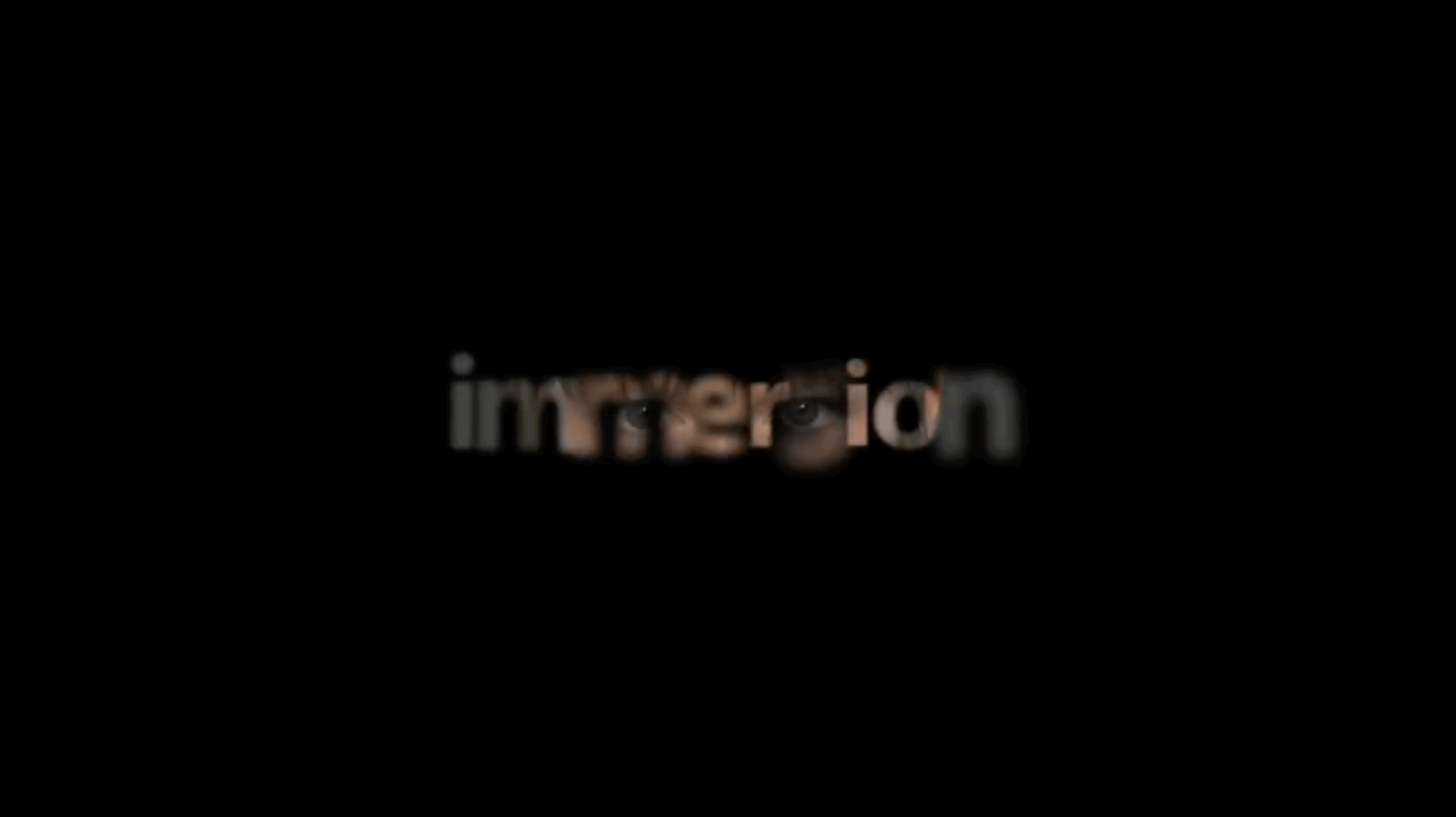
The English artist-photographer Robbie Cooper became semifamous in 2008 with the widespread online release of a roughly three-and-a-half-minute video titled Immersion. It still lives on the internet and is unlikely ever to go away. The short film consists of a set of sequential cuts, all similarly framed and ranging from six to fifteen seconds, of kids playing various video games. Sometimes, one sees only a single player. In others, the player is accompanied by one or more friends, who appear only to be looking on at the action; they are not “playing.” Across all the shots, the only sound is that of the game itself—together with whatever yawps and comments the humans add in the throes of their gaming.
What made the whole thing go viral (-ish; 2008 was a long time ago—the iPhone had only just come out, and Twitter, Facebook, YouTube were all still in their infancy) was the uncanny intimacy of the camera: one watched the kids playing the games through the screen at which they were looking. The intensity of their searching gazes, the strained grimaces or unsettling complacency, the lip-biting trance-field of total absorption—all this is directed at you, directly. It is shot from the point of view of the screen itself.
Many filmmakers, going back to some of the earliest experiments with the moving picture, have depicted the intensity of the gazes fixed on their own medium. One thinks of Dziga Vertov’s interwar metacinema, or even a vaudeville-steeped silent classic like D. W. Griffith’s Those Awful Hats (1909). It was something they thought about a lot, early cinematographers—the mesmeric power of their own images. And so it was a very alluring topic to explore.
But it is one thing to shoot an actor who has been told to make a face “as if” he is looking at a movie. It is another to put the camera in the movie screen itself, and then to play the movie and record the actual reaction. This is a much more recent technique. To be sure, shots of people seeing things in the world are a cinematic commonplace. But the majority of such imagery captures these reactions within the established triangle of subject, object, camera. It is much rarer for a filmmaker to close that triangle down into pure bilateral eyeline gaze: to film from the perspective of the thing being seen, where that thing is itself a moving image.
Over the past fifteen years, FaceTime and Zoom have made this kind of shot feel much less strange. Indeed, the British reality TV series Gogglebox, which launched in 2013, is built out of the conceit: we watch folks watching television from something like the point of view of the TV screen itself. But in that show, as in our video-call applications, the eye (or the mind?) generally remains conscious of the slight parallax that separates the camera’s perspective from the actual sight line of a person looking at their screen (the camera on our devices is generally mounted just above the display; Gogglebox mounts its cameras just to the side of the family telly). The only way to eliminate that residual triangulation is to put the camera itself right in the middle of the screen—to have it shoot “through” the visual image itself. But how to do that?
To solve this problem, Robbie Cooper used a trick that had been developed only a decade earlier by the celebrated documentary filmmaker Errol Morris. Morris had long pursued a kind of direct-eye-contact look in the footage he recorded of his interview subjects. And he had always chafed at the way his subjects either had to look at him as they spoke (which gave a natural, direct, conversational quality to the face, but meant the camera had to look on from the side) or speak directly to the camera (which inevitably prompted more performative or stilted demeanors). For years, his solution had been to position his camera tightly at the edge of his own head as he conducted interviews. This narrowed that triangle down as much as possible—but also looked and felt a little awkward for everyone. It annoyed his camera operators, too, who fretted at his forever encroaching on the edge of their frame.
The solution lay in a clever hack on the familiar technology of the teleprompter. Back in 1954, Jess Oppenheimer, a producer on I Love Lucy, applied for a patent on a refinement of the then-available device for feeding lines to actors and politicians: the old systems simply scrolled through rolls of text placed somewhere near the camera (which produced “shifty” eyes, as performers could be seen to sneak a peek, now and again, at the script, which was always a little off camera); to fix this, Oppenheimer rigged an angled plate of polished glass right in front of the lens, and arranged the script rolls in such a way as that they could be seen in a ghostly reflection exactly where the actor was supposed to be looking, because the camera was shooting through that plate of glass.1
What Morris did was configure a high-quality see-through mirror at a teleprompter angle in front of his camera. But instead of having it reflect a scroll of words, he had it reflect the image of another TV monitor, on which his own real-time face was depicted. This meant that a subject could look straight ahead and see nothing but the face of Errol Morris himself, just as if it were a live interview being conducted remotely. The conversations unfolded this way, with the subject settling into a natural eye-contact conversation with Morris’s image—as, all the while, a camera behind that mirror glass recorded the subject’s face as Morris would have seen it had he been physically present in the location of the lens itself. You were thus able to watch, in The Fog of War (2003), the former secretary of defense Robert McNamara both drill down into the eyes of his interlocutor and, here and there (crucially), evade them. Morris called his system the Interrotron—the idea was that this got the word terror in there. He was only half joking. It made for an extraordinary kind of documentary intimacy.
In place of the live-video feed of an interviewer, Robbie Cooper put the real-time video-game screen, playing on a banked sheet of reflective glass—through which the camera, again hidden from view, peered. And so one is, for the three minutes and eleven seconds at the heart of Immersion, the object of attention.
What makes for the intensity of this experience?
First, the players are children. They range, I would guess, from nine or ten to perhaps fifteen. And though one cannot see what they are seeing, one can tell from the sound effects (as well as, now and again, the looks of concern—even, in a few cases, real discomfort, and perhaps authentic sorrow—on their faces) that they are engaged in scenes of extreme violence. Realistic gunfire pops randomly. Shell casings clink across the cement in a silent and cavernous room. Panicked voices call for help over walkie-talkies. There is something immediately disquieting about watching children navigate the implicit brutality of these scenes. When their faces betray distress, that registers as a child in distress. When they erupt into cavalier glee (“You got knifed! He-he”), it is not less disturbing. The young woman to whose implacable and perfectly undemonstrative cold stare the camera returns several times offers yet another unsettling alternative: the soundscape she addresses with totemic fixity makes clear that she looks upon mayhem, but she does so with a composure that, at least in appearance, limns psychopathology.
There is also the sense of transgression that comes with voyeurism, and the queasy miasma of dishonesty in which we feel ourselves mired when we engage in surveillance. After all, whatever these kids understand about the gamified Interrotron into which they are staring, they certainly appear to have forgotten that we are here, we viewers. And so it is impossible not to feel that one is spying on them—catching them unawares in moments of frontal, undisguised disclosure. There is an erotics to this, to the peeping into the eyes of someone so thoroughly engrossed. But why those feelings operate is not clear. And that they do registers only vaguely—as discomfort. It isn’t right, all this: to be so close to someone, doing something so private, and without their knowing everything that they are showing. Most of us, somewhere along the line, received some sort of very subtle social formation that made this kind of looking at another person feel wrong, somehow. And that we are here being put in that position with children heightens the moral ambivalence—amplifies the uneasy static vibration of a violation field. They should know we are here. Or we should leave.
The faces themselves are specific, lively, inhabited; seemingly unselfconscious; engaged. A tongue lolls out for a moment, cheeks huff with quickened breath. In one sequence, which does not escape feeling kitsch, an eye waters up, and a single tear eventually brims over and rolls down a cheek. Could this be crying? Or is it simply that she hasn’t blinked in forever? And when, in another clip, an extravagantly lascivious female voice narrates to the young player a sexual encounter of mounting heat, his wide-eyed indulgence in the fantasy ripples across his face in a wave of slacks and twitches. As lookers-on, we might wonder how our own faces are working in mirror-neuron sympathy with theirs.
But there is something else, too—something toward which I keep reaching. The sequence of video footage Robbie Cooper calls Immersion offers an extraordinary kind of portraiture. I think it would not be wrong to say that he has “taken pictures of attention” in a remarkable and possibly unique way. This is the effect of a kind of double subtraction: both the observer (the camera) and the object of attention (the game) have been removed from this footage. What is left is a kind of pure picture of the attentional act, caught in the act.
This is attention.
And it is unsettling because it is pure attention, glimpsed very close to its own threshold of seeability. A person lost in attention is a person lost. Cooper captures something of the edgy antinomy that lurks at the limit case of attentional commitment: we “are” our attention; but when we are attentive, we aren’t “there”—at least not for others. And perhaps not even for ourselves.
This is, perhaps, the deepest and most unsettling paradox of human attention. The vacancy of perfect distraction and the intensity of extreme focus, seeming antitheses, turn out, at their limits, to be indistinguishable. There is something ever so slightly frightening about this. And it is worth sitting with that fear—since it is a fear that permeates our attention-addled age.
At the same time, however, the antinomy may contain its own emancipatory promise. Our “attention economy” has, across the past two decades, radically transformed our days, as well as our experiences of the world and each other, and it has substantially remade the phenomenology of personhood. When we raise our heads from our screens, what we see, often, now, is others, looking at their screens. Are we as lost to ourselves, looking at our phones, as they seem to be, looking at theirs? If the deepest forms of attention are always aporetic, we may need to let this anxiety go.
The spiritual exercise of our time may derive its liturgical dramaturgy from the Interrotron: the next time you see someone lost in the scroll on their phone, take a moment, in your mind’s eye, to look up at them, lovingly, through their screen; be with them at the vanishing point of themselves.
[1] This required, of course, one other reflection, lest the text appear inverted. An actual mirror, placed before the teleprompter, did the trick. The total setup was thus a little like a periscope. The patent is easily consulted (it is U.S. Patent 2,883,902). The camera was indeed shooting “through” the reflected words, but because they were faint, reflecting away from the lens itself, and not in the focal plane of the camera, they did not compromise the image.
D. Graham Burnett is a writer and maker. He is a part of the speculative research collective ESTAR(SER), a founder of the Strother School of Radical Attention, and a member of the Friends of Attention collective, who authored ATTENSITY! A Manifesto of the Attention Liberation Movement. He is the Henry Charles Lea Professor of History at Princeton University.