

Kevin Brazil
By Kevin Brazil

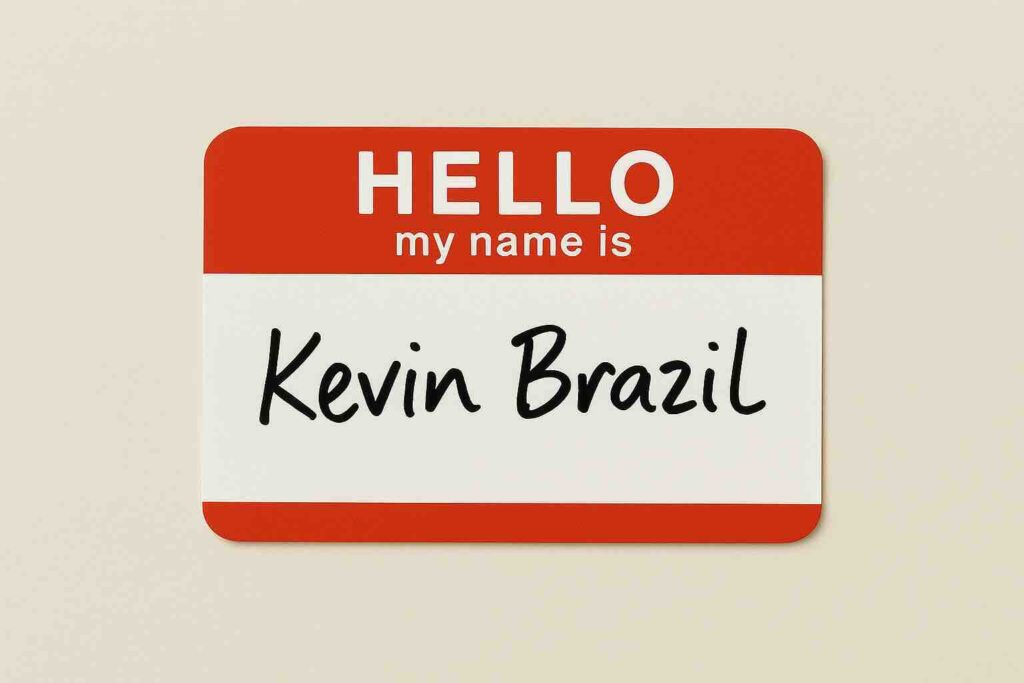
I’ve never liked my name: Kevin Brazil. I don’t hate it; that would be going too far, and besides, if I really did hate my name, I would have changed it by now, as I still vividly remember discovering you could, when I was fifteen, from a boy in school who said he had always hated his name, Martin Young, and was planning to change it as soon as he turned eighteen, the legal age at which you can change your name in Ireland, which is where I am from. I wonder if he ever did.
When I say I don’t like my name, I mean that it doesn’t appeal to me. Aesthetically, visually, acoustically. There are too many consonants, which make it pointy, sharp, angular. I don’t like the sounds of the letters v and z. To me, they are the sounds of threats, buzzing insects, or high-speed cars—va-va-vroom!—and I find moving at fast speeds scary, not exhilarating. I disliked all these things long before I learned that in countries outside Ireland—France and Germany, in particular—the name Kevin is the object of a unique mockery for being a name given to working-class, banlieue-inhabiting, former East German white-trash boys whose equally trashy mothers, probably called Cindy or Chantelle, were influenced by American popular culture in the nineties, specifically the Home Alone movies starring Macaulay Culkin. There are entire books published in France about the shame that comes with being called Kevin. German even has a word for the stigma associated with my name: Kevinismus.
But this is all a little superficial. When I say I don’t like my name, what I really mean is that I don’t think it’s my name. I don’t feel like someone is referring to me when, in the middle of a conversation, they say, “And what about you, Kevin?” When someone calls me Kevin, I don’t feel anything at all, not even the icy emptiness of alienation. Just—nothing. And it’s funny because I myself know the power of calling someone by their name. One thing I like to do when I’m flirting, especially over text, is to suddenly refer to someone by their name in the middle of a conversation. “Now, Leo, I think you can do better than that …” It’s intimate, the verbal equivalent of staring into someone’s eyes. Guys really respond to it; I can see it working. It really makes them like me, at least for a while. Try it yourself—I imagine it works the same on women, but I am and always only have been a homosexual, so I wouldn’t know. But when guys do it to me? Even during sex, whispered in my ear? Nothing. I actually dislike it. It makes me feel like they are speaking to someone else, in love with someone who isn’t me.
Those are just some of the issues I have with Kevin. Where to start with Brazil! I’m so practiced with dealing with questions about my surname that I’ve developed a whole bit: “No, I’m not Brazilian, unfortunately! You see, Brazil is the English transliteration of an Irish surname, Ó Breasaíl. Most Irish names have English equivalents. Irish is an older language than English, the oldest vernacular in Europe, don’t you forget it! During the English colonization of Ireland, Irish names were transliterated in English—imagine a census in the seventeenth century, an English soldier writing down the names of the peasants whose land he has stolen. Ó Breasaíl? Sounds like Brazil. Kevin is also originally an Irish name, Caoimhín, which is pronounced 'qwee-veen' and ended up in English as 'Kevin.' Not only did colonization by the English lead Irish people to lose their names, but eventually, due to legal discrimination and the Great Famine, it led to the death of the Irish language itself, and we also lost the ancient meaning of those names. You see, Irish names mean something. Caoimhín, a.k.a. Kevin, means 'handsome and generous.' And Kevin was a very famous saint, known to be kind to animals. Not me, really—I’m too much of a control freak to be generous, and I can’t stand pets. Ó Breasaíl—my surname could mean two things. I’ve researched this quite a bit. Either ‘from strife,’ so my name would mean something handsome and generous that has come from strife. Or it could refer to the land of ‘Hy-Brasil,’ which in Irish mythology is a mythical island on the other side of the Atlantic Ocean. Sort of like our Atlantis, but Irish people have their own separate and unique mythology that we learn about extensively in school. The Salmon of Knowledge—look it up. The second meaning is the one I prefer. Handsome and generous and from a mythical magical land—that’s who you are talking to!”
That’s what I might say on a date, to fill an awkward silence at a party, to stall, to entertain. I’m just not sure if all of it is really true. The etymology of Kevin—that’s true. The transliteration of Irish names into English: true in a general sense, but it’s also true I like to emphasize colonization and famine to play the victim; it gets people on my side, either by making them feel I’m in solidarity with the oppressed of the world or by making them feel guilty, which can be a surprising short-circuit to affection. Hy-Brasil, that definitely does exist in Irish mythology, but I’ve never seen any mention of it being relevant to the name Ó Breasaíl, which is just a rare and obscure family name in Ireland. And that whole spiel about Irish names “having meaning”: that’s about vaguely implying that, by virtue of being Irish, I am the kind of person whose language has some vestigial organic connections to the land and so am a living repository of ancestral wisdom, to double down the effect of solidarity and/or guilt.
This whole bit is just a way of deflecting from the reality that I just don’t feel any connection to the name I have been given. It’s also a way of deflecting the guilt that, in saying I don’t feel any connection to my name, I’m accusing my parents of something. I’m not! I love my parents; I really do. This isn’t a setup for the well-worn trauma plot of a family memoir. My dislike of my name has nothing to do with any choice my parents may have made, which is a point in itself about the limits of parenting, and a sad one. You can do everything right, and your child will grow up feeling something so primal as a permanent and deep-seated disconnection from his name.
It’s strange: something as personal as our name is given to us by someone else. I mean, it’s literally as personal as it can get. The very thing that distinguishes us from other people, the word that makes you “you,” is chosen for you without your consent by other people, unless we later decide to change it, most commonly through religious conversation or transitioning. And these experiences are often associated with being born again, being saved, becoming who you always were, finally being seen—all this should indicate that there is, in fact, something at least unusual about allowing someone else, even the most loving parents, to choose your name for you. The name you are given: It’s a roll of the existential dice, a sign we really are thrown into a world against our will, and we have to make our own meaning within it. Except we rarely do make our own meaning in life, do we? It’s not like I’ve been brave enough to choose my own name. And who among us, apart from a few rare cases, does have a unique name? Even a name as comparatively unusual as mine is in fact shared by other people.
I’m not above googling myself—although I swear I do it only for professional reasons—and it was after I had published my first academic book and wanted to see if it was available online that, in searching for “Kevin Brazil academic,” I first discovered there was another Kevin Brazil. Like me, he is a professor at a university. Professor Kevin Brazil, it turns out, is a specialist in palliative care at Queen’s University Belfast who, according to his website, researches “quality care for family carers and patients as they near the end-of-life.” Who was this older Kevin Brazil who had the same job as me and had devoted it to the one thing I am terrified of: death?
That was the first discovery that made me think that the significance of my name might have nothing to do with its etymology or what it says about me but rather that it might lie in the coincidences I had just discovered. Was it by chance that I had something in common with the first other Kevin Brazil I had ever come across? Do names in some way determine the course of our lives? And not in the ways we know they do—sociologically (see Kevinismus), ethnically (see Caoimhín), and how people read our gender and sexuality (see flirting; all above)—but in some other, less immediately obvious sense, pointing toward the combination of chance and fate that shapes how we make any meaning out of our lives. Rationally, logically, and objectively speaking, I shouldn’t have had anything in common with this randomly selected person just because we shared the same name. And yet here I was wondering: If I had been born another Kevin Brazil, would my life have been all so different? Or, deeper horror: Would it have turned out the same?
I put aside these questions about Kevin Brazil for many years, until once again I found myself googling myself—again, for purely professional reasons. As someone who barely uses social media because, honestly, I’m afraid of it, I’ve always wondered what impression of me someone would get if they searched for Kevin Brazil on X (the platform formerly known as Twitter). Well, it turns out they would discover that Kevin Brazil has published many research papers (about death), given many online lectures (about death), and posted about winning many awards (for research into death). Professor Kevin Brazil was back in my life, and I soon got bored trying to find the few tweets about me and more interested instead in the question of what I could (legally) learn about this Kevin Brazil, and by extension anyone, by investigating everything they had made public about themselves. And not just online: There are traces we leave in the electoral register, tax returns, land deeds, so on. Public records are what enable private investigations, as every biographer knows; Kevin Brazil would never have to know Kevin Brazil was investigating Kevin Brazil.
I never got around to answering that question because it was while searching for details about this second Kevin Brazil that I got sidetracked by the discovery that there was a third Kevin Brazil living in Ireland. This Kevin Brazil, at the age of fifty, was convicted in court of sexually abusing a twelve-year-old boy in 2020. Four days after receiving a suspended sentence for this crime, he sexually assaulted another young boy. By the time he was eventually sentenced to eighteen years in prison, police investigations determined that this Kevin Brazil had committed over thirty acts of sexual abuse against young boys over the course of his life.
Reading about this Kevin Brazil was an upsetting experience. It was disturbing for me to search through newspapers online and read sentences like “Kevin Brazil sexually assaulted the boy while taking him on drives in his car.” Worse were sentences like this: “He said before he met Brazil he was a happy child. He said the depression now impacts on his family life and means he cannot live in the same house as his partner and their children.” Or this:
The victim said that he did not deal with the psychological effect of what happened to him ‘at all well’. He said that had he not had to endure what Brazil did to him, his life would be different now.
He said he had great difficulty interacting with people one on one. He said he feels threatened by gay males, something he feels bad about because he knows the vast majority of the gay community are good people.
This Kevin Brazil came to embody the fear I had absorbed growing up that as a gay man I might also be in some way a pedophile or that I would be exposed to the danger of being abused by a pedophile. I was not sexually abused as a child. But shortly after I turned eighteen, I discovered that the coach of my swimming club had abused other members of my swimming team. Many years later—in therapy, where else—I realized that the fact I had spent much of my childhood unknowingly surrounded by the sexual abuse of other children had left me with a deep skepticism as to whether we can ever really know anything about what is happening to us and an equally deep cynicism about most (but thankfully not all) people’s motives.
While this skepticism and cynicism might be all my own, that I grew up surrounded by sexual abuse is sadly something I share with many more people than those who share my name. Thousands upon thousands of children were and still are sexually abused in Ireland. In the aughts, the Catholic diocese in which I grew up, Ferns, was believed to have the highest rate of clergy accused of sexual abuse in the world. I hate this about Ireland; I hate this about the church. It is one reason I will probably never feel at home in the place where I was born.
I thought that the story of this Kevin Brazil would be the most unsettling I could discover through the chance coincidence of a name. But there are many ways in which doppelgängers can disturb our sense of self—or at this point should I say quadruppelgängers, because when searching for stories about the third Kevin Brazil in online databases of newspapers, I discovered something strange in the local paper of the town where I grew up, the New Ross Standard. Kevin Brazil appeared in far more stories than I would have expected: in reports on school plays, pantomimes (I was a moderately gay child), parades, and most often, in reports on my success as a swimmer, for I won many competitions and got so far as representing Ireland at the Youth Olympic Games in Paris in 2003. I also discovered that in 2002, one year before the crowning achievement of my teenage years, Kevin Brazil from New Ross had been charged for smashing a car window while under the influence of alcohol. I had never done that. I thought this must have been a mistake—a typo in the newspaper?—but further searches revealed it to be true: that in the small town in which I grew up lived someone with the exact same name as me, someone I never knew existed.
New Ross is a small town, population about eight thousand, and my father had grown up in the town, as had his parents, my grandparents, and the generation of Brazils before that. My father had six brothers and sisters, all of whom I had known growing up—seeing them once a year at Christmas as children and then not at all—most of whom still lived in the town where they were born and whose children, my cousins, I also had met, albeit a long time ago now. My sister lives in New Ross, my parents ten minutes outside it, and as a small town, it’s not a place where it’s easy to live in secret or anonymously. And yet when I asked my sister whether she knew about this other Kevin Brazil, she, like me, had no idea.
So I looked him up on Facebook, and there he was. Kevin Brazil, living in New Ross, his profile picture a child having the time of their life in what I eventually recognized was a swing in the town park. I’ve swung in that swing. I have no children of my own, but as recently as last Christmas, I pushed my niece and nephew in that swing, and they were as happy as Kevin Brazil’s own child had been (and could be?). All I know, from the newspaper reports and this profile, is that this Kevin is seven years older than me, seems to have a child, was arrested at twenty-two but was released on probation, and lives in a street that was mostly council housing and known as a “rough part of town.”
I didn’t love the town in which I grew up, but I didn’t hate it either. It was a town in decline—there’s no doubt about that—affected by global trends in deindustrialization, drug use, and migration that made its difficulties far from special. I knew that this made it the kind of town into which two near identical people could be born and end up having what we euphemistically call “differing socioeconomic life outcomes.” I knew it’s the kind of town to make you wonder what causes those kinds of differential outcomes; I just never would have thought it was the kind of town in which someone could have the exact same name as you and you would never even know they existed. Unless the fact of that quiet and unknowing alienation is part of what explains those “differing life outcomes.” It certainly explains why my reflex was to assume that my life was somehow better than that of this person I know almost nothing about.
I wonder if this Kevin Brazil knows about the other Kevin Brazils. Maybe (unlike me) he volunteers at a care home for older people; maybe there he got chatting with a nurse who told him about the research of Professor Kevin Brazil. Or maybe he volunteers for a charity supporting prisoners (again, I do not), where he met the criminal Kevin Brazil, who by now could be approaching the end of his life and is part of a study conducted by Professor Kevin Brazil, and maybe they all have crossed paths or are at least aware of each other’s existence. But I doubt it. I imagine instead that Kevin Brazil is content, still living in the town where he was born, taking his child to the park every day after school, swinging his child on the swing.
Kevin Brazil is the author of Whatever Happened to Queer Happiness? His fiction and essays have been appeared in Granta, Harper’s Magazine, and The White Review.