

Indian Names
By Julian Brave NoiseCat

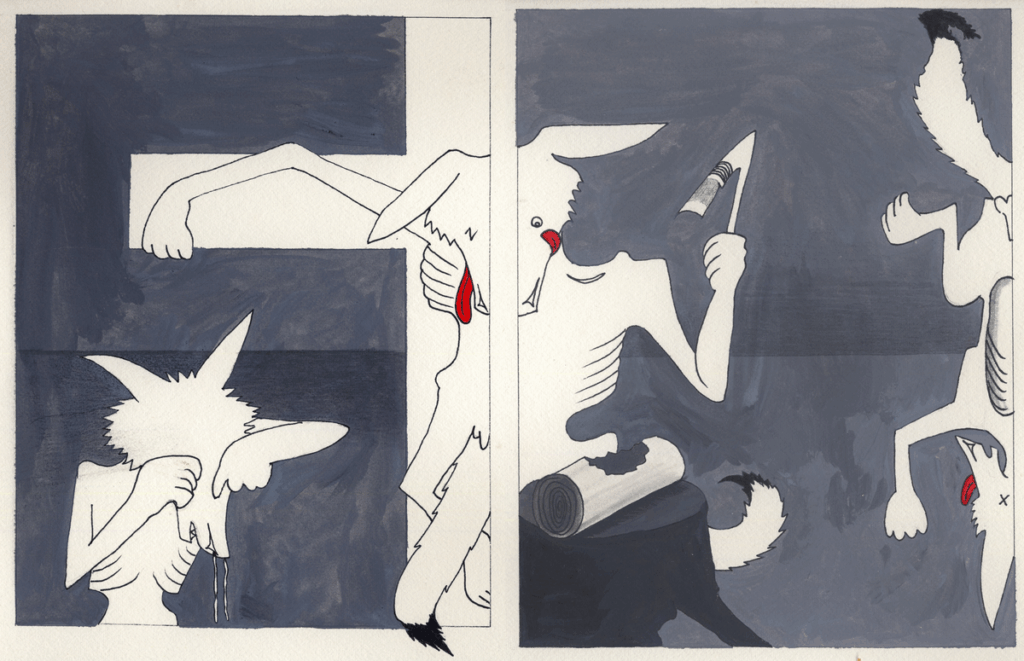
The night watchman who found my newborn father in the dumpster said his cries for life sounded like a cat. But that was pure, if darkly ironic, coincidence. Because our last name, NoiseCat, originally had nothing to do with noises or cats.
Instead, “Noiscat,” as it was once written, is a missionary’s bastardization of our ancestral name, Newísket. My family was colonized so hard we don’t remember what Newísket means. What I do know is that the name belonged to my great-grandmother Alice Noiscat from the village of Canoe Creek on the Fraser River. Listening to family and elders, I figure Alice was either a daughter, granddaughter, orphan, or slave of Copper Johnny Noiscat. Copper Johnny must’ve been both clever and industrious. During the Gold Rush and subsequent settlement of the colony and then province of British Columbia, he laid claim to a meadow that still bears his name. Today, Copper Johnny Meadow Indian Reserve No. 8 is part of the reserve lands of the remote Stswecem’c/Xget’tem (Canoe Creek/Dog Creek) First Nation. I’m not sure what Copper referred to. Maybe it referred to his red skin—a name stuck on him by semé7 (whites) who gave Indians names for amusement and convenience: “Oh yeah, this one’s ‘Indian Jim’ and that one’s ‘Copper Johnny.’ ” (In Secwepemctsín, the 7 denotes a glottal stop. The word kyé7e, “grandmother,” for example, is pronounced “kya-ah.”) Or maybe it referred to his wealth. In the Indigenous Northwest, copper is a prized trade good signifying that its owner has a wealth of food and culture to share. In a world where Indians had all our land taken from us, an Indian with land like Copper Johnny was rich. Copper Johnny Meadow may be the ancestral territory of the Newískets going back to some mythic progenitor whose deeds were marked and remembered on that land—through creation, transformation, and forces both natural and supernatural that make our world the way it is—all the way back to Coyote and whoever the first Newísket was. Or maybe, Copper Johnny is that first Newísket. He’s the oldest one we still remember today.
Based on conversations with my kyé7e, Alice’s daughter, the name Newísket could mean a couple of things—maybe “Long Day” or “Tall Timber Day.” But to see how that might be the case, it’s necessary to understand some of the history and peculiarities of Secwepemctsín and the Salish languages. Because like the meaning of my name, my ancestral tongues are fast slipping from the Land of the Living to that of the dead.
Salish languages are what linguists call agglutinative. Which means speakers make words by combining morphemes—linguistic units of meaning—into words and phrases. Fluent Salish speakers are, in this sense, constantly making words. The very act of speaking the language is an act of creation and transformation. For example, Secwepemctsín, the word for our language, combines our endonym Secwépemc with the suffix -tsín, which means “mouth” or “speech.” Secwépemc, in turn, combines cwep, meaning “spread out,” with -emc, the root morpheme for both land and people. According to the Dutch linguist Aert H. Kuipers, versions of this suffix are common to all Salish languages and can be traced back to the proto-Salish word tmícw.
Salish languages have been studied extensively by linguists because of their challenging phonology, which is likely evident in your attempts to sound out the Secwepemctsín words I’ve used here. In some Salish languages like Nuxalk, spoken in Bella Coola, British Columbia, there are entire words composed only of consonants. For example, the Nuxalk word clhp’xwlhtlhplhhskwts means “he had in his possession a bunchberry plant.”
The comparative study of Salish languages led the American linguist Morris Swadesh to develop a statistical approach to linguistic analysis called glottochronology. Glottochronology starts with a list of core vocabulary, usually a hundred common words, known as a Swadesh list in linguistic parlance. Across languages, these lists are compared to identify cognates. Languages with more cognates are more closely related. Languages with fewer cognates are more distantly related. When glottochronology is applied across multiple languages from a single language family like Salish, which has twenty-three distinct languages including Secwepemctsín, linguists can construct a proximate vocabulary of the ancestral tongue that was spoken before those languages diverged.
Salish languages are often grouped into two branches: Interior and Coastal, with Nuxalk and occasionally Tillamook from the Oregon Coast, sitting apart from these two. They have changed over time. Swadesh likened this process to radioactive decay and asserted that the date when languages split could be estimated using statistical analyses. Swadesh’s method suggested that all Salish-speaking peoples, whose homelands span parts of Washington, Oregon, Idaho, Montana, and British Columbia, spoke a common language until about 5,500 years ago, when Coastal and Interior Salish diverged. Subsequent studies by the anthropologist and linguist William Elmendorf pushed back the date of that divergence to 6,900 years ago.
Using a reconstructed list of words for plants and animals in proto-Salish, proto–Interior Salish and proto–Coast Salish, the linguist M. Dale Kinkade deduced that the homeland of proto-Salish must be coastal because proto-Interior Salish retains words for plant and shellfish species found only on the coast. (Interestingly, words for “horse clam” and “geoduck,” large shellfish with phallic-looking necks, became words for “snail” in Interior Salish languages. T’əmyéq means “geoduck” in Lummi, spoken in Bellingham, Washington. T’am’yó means “snail” in Flathead, spoken in Arlee, Montana.) By mapping words onto ranges for flora and fauna, Kinkade identified the lower Fraser River in present-day British Columbia and the area south as far as the Stillaguamish River in present-day Washington State as the likely Urheimat of Salish civilization and language.
Starting about five thousand years ago, Salish ancestors on the Fraser River built round winter homes into the earth that were called c7ístkten, kekuli, or pithouses. Salish pithouse builders spread their salmon-fishing culture up the Fraser River into the interior, where they encountered nomadic hunter-gatherers who left behind distinct, lightweight stone microblade tools befitting their mobile culture. For about a thousand years, the sedentary Salish coexisted and intermingled with these nomadic hunters. Then the two merged, creating the Interior Salish and giving rise to a distinct subfamily of languages. Coyote’s name—Sek’lep in Secwepemctsín—likely dates to this era and has cognates in all Interior Salish languages:
N’kyap in Ucwalmícwts (St’at’imc language)
Sn’kyap in Nlaka’pamuxcín (Thompson language)
Snk’lip in Nsyilxcn (Okanagan language)
Snclé in both Qlispe and Sélis (Kalispel and Montana Salish, respectively)
Coyote Stories relate ancient memories of geological, climatic, ecological, and cultural transformation. This antiquity was acted out in the telling. When our downriver neighbors the Nlaka’pamux performed their cycle of Coyote Stories, the trickster not only spoke in a high-pitched tone like a coyote, he also spoke Secwepemctsín, the language considered most akin to the ancient tongue of the trickster and the people of his day. I mostly use Secwepemctsín, the language I learned from my kyé7e and that she, in turn, spoke with her mother, Alice Noiscat. Because that’s the way our trickster ancestor and his descendants spoke.
As the root morpheme cwep, meaning “spread out,” from our endonym Secwépemc suggests, my ancestors spread north across the rivers and plateaus, fishing the Fraser and its tributaries like Canoe Creek, where my great-grandmother once lived, our tongues slowly transforming to fit these new geographies. In the winter, our ancestors built pithouse villages into and out of our tmícw, our living earth which is also animate, at places like Copper Johnny Meadow. In our oral histories, Coyote often sculpted himself and others into and from the land. Because the words for “human being” and “earth” share the same root, when we name people or place in our language, we are sculpting ourselves, our nations, our villages, our rezzes and their names into and from the land—like Coyote and the pithouse builders.
And like the trickster, speaking our language can also be an act of play. Aert Kuipers worked with May Dixon, an elder from Tsq’escen (Canim Lake), and other fluent speakers to codify a Secwepemctsín curriculum in the seventies. May and her friends decided to give Aert’s people, the Dutch, a Secwépemc name: Sxetsxts’icén̓ (Wooden Feet), a joking reference to their clogs. Kyé7e always laughs when she says that one.
Back to my name. Like all Salish words, Newísket can be broken into its constituent parts: newis, which may mean “tall timber,” and -ísket, meaning “the day of.” My best guess, again, is that Newísket means “Tall Timber Day” or “Long Day.” The former is intriguing because I come from people named after trees and tree parts. The son of Coyote is Yekw7úscn (Stump). My pé7e (grandfather) was given the Indian name S’Zik (Log Lying Down). My father is a carver. And the man who found him in the dumpster was, in our language, a Sxetsxts’icén̓—a wooden-footed person. But the latter, Long Day, seems to me more likely. And it feels even more significant. Because every year for the four years while I worked on the Coyote Story that is my book, I fasted four days and four nights with no food and no water in a ceremony that spans the longest days of the year. Because for my people, like for many other Indigenous peoples, the summer solstice is sacred.
In James Teit’s 1909 ethnographic text The Shuswap, I found reference to a warrior called Newísesken. Newísesken and his brother Aná’na brought a murderer, horse thief, and kidnapper to justice near the Fraser River—a tale that reminds me of my dad and his more than occasional and sometimes belligerent fists of justice. I don’t know if Newísesken is the same as Newísket, and if so, if he was my ancestor, my ancestor’s owner, or the ancestor of my ancestor’s owner. But there isn’t an Indian I know who wouldn’t want to be descended from a righteous warrior.
Or maybe he or she or they are all of that? Their identity transforming alongside our family and our relationship to land, language, and lineage. To our relationship with our ancestors like the enigmatic Coyote, who was constantly transforming and could not be defined as just one thing. I like to think of the meaning of Newísket as forgotten, plural and transitioning at the same time. The meaning of my name is shapeshifting, diverse, maybe even righteous. And possibly connected to wood, the summer solstice, or both.
Or maybe, my name really is dead. Maybe the ideology that condemned my father to an incinerator did its job, turning our millennia-old Salish language, world, and Weltanschauung to ash. Maybe we are extinct, and I am none of these things. Nobody, like Dad when he first showed up in New York, a printmaker fresh out of art school. Or Victor Joseph’s favorite Indian in Smoke Signals. Or Gary Farmer’s character in Dead Man: “He who talks loud but says nothing.”
But death is not permanent—at least not this kind of death. No, this cultural and linguistic death is, as the trickster told us, like sleep. Because the Land of the Dead is right there at the other end of that red road. Our ancestors speak this language and know these stories there. They have our names. And they could bring it all back, if only we could reach them.
I went out to Canoe Creek to see Alice Noiscat’s home with my kyé7e in 2013 when I was twenty. On the road, we saw an unusual black bear, its coat streaked with cinnamon and blond, run into the bush. “Sq̓wtews,” Kyé7e said.
“What does that mean?” I asked.
Kyé7e held up her thumb and pointer fingers like she was taking a half measurement of something. “That bear is sq̓wtews like you.” I chuckled uneasily because she wasn’t wrong.
At Copper Johnny Meadow, an old cabin no bigger than my kitchen stood beside a small shed on the edge of a wood. The cabin, little more than four walls without a roof, felt lonely. The meadow was tanning under the summer sun. Alice must have been a rugged woman to live on that land.
The settler society closing in on Copper Johnny Meadow was a cruel place for Indians. When Alice spoke her language—the one that connected her to family, ancestors, land, spirits, Coyote, Creator, and Creation—white people in their white towns laughed at her. Alice wanted no part of their world. She tried to prevent Kyé7e and the rest of her children from being taken to the Mission—which was a crime at the time. Of Alice’s eight children, one died as a little boy and seven were forced to attend Saint Joseph’s. Alice did not get to raise a single one.
My father is the oldest of Kyé7e’s nine children. She was not married to Pé7e when she got pregnant. She was a devout Catholic. He was a womanizing Coyote. So, she hid the pregnancy from him and, seemingly, most others. A child born out of wedlock could be taken away. And on many nights at the Mission, Indian babies were abused and discarded like trash.
The story of Dad’s birth and abandonment at St. Joseph’s has long been whispered but seldom spoken. When Dad was discovered and brought to the hospital in Williams Lake—the same hospital where Kyé7e worked as a nurse—his temperature had fallen to 95 degrees Fahrenheit. His soul had already started to drift down the red road to the Land of the Dead. His discovery and survival were, according to the night watchman who found him, an “act of God.”
The Royal Canadian Mounted Police opened an investigation. They threatened to examine every Native woman in the area. Kyé7e was apprehended. She pleaded guilty and was sentenced to a year in jail for abandoning her child. According to the Williams Lake Tribune, if Dad had died, the crime would have been murder.
The incident raised troubling questions in the surrounding community. A column in a subsequent issue of the Tribune examined “The Unfortunate Case of the Unwed Mother”:
This woman was definitely above average of her kind in intelligence, training and outward appearance, in fact was successful in obtaining a position in the local hospital—no mean feat in itself. It is no longer uncommon procedure for these unwed mothers to enter hospital for the birth of their first child. It seems passing strange, therefore, that a girl already somewhat attuned to its surroundings should choose to journey several miles, assume the risk and endure the anguish of delivering her first-born in dreary solitude when she could so easily have availed herself of the skills and care of her associates. What intangible force could possibly impel her on such a course? Needless to say some male person contributed to her fall from grace. Did he or some other person very familiar with routine procedure at the Indian Residential School instruct and persuade her in the course she pursued while assuring her all evidence would be completely destroyed without being discovered, thereby reducing to the absolute minimum the danger of being apprehended? The matter of intimidation cannot be totally ruled out.
These were not questions raised by Canada’s Truth and Reconciliation Commission, Native activists, or even investigative journalists. They were raised by A. J. Drinkell in a recurring column for the Williams Lake Tribune called the Cracker Barrel Forum.Whenever someone tells me the Mission’s troubling history was “hidden” and that they “had no idea,” I struggle to square those statements with the fact that a conservative small-town paper was asking damning questions about “intimidation”, “intangible force[s],” and “routine procedure at the Indian Residential School” in 1959.
The Indian residential schools were, in the words of one of their Canadian architects, designed to “get rid of the Indian problem.” I think, on some basic level, society knew what it was doing with Indians. It was stamping out all the Indian in us and throwing us away. And eventually, that’s what we started doing to ourselves. Kyé7e remains the only person ever punished for the infanticides perpetrated at Saint Joseph’s. And Dad is the only known survivor of the school’s incinerator.
After Dad was found by the night watchman, he was picked up from the hospital by his grandparents, Alice and Jacob, who raised him for much of the first seven years of his life on the Canim Lake Indian Reserve. He was the only child Alice had the chance to raise. And Alice was the first mother he knew.
Dad remembers Alice towing him out onto the Archie family trapline with their horse named Earl and a sled made from an old car hood. Together, they would check the traps, pulling frozen beaver and muskrat out of the water so she could sell the fur and feed the family. They didn’t have much. Hunger was common. But Alice was generous with her grandson. Dad remembers the time she found a fresh apple—a hard thing to come by on the rez, even today. She fed it piece by piece to her grandson, keeping not one bite for herself.
Dad remembers and still recites some of the little kid words Alice used with him. When they woke in the morning in their tiny, drafty cabin where the cold seeped under blankets as the fire dwindled overnight, she would take a rag to his face to wipe the cts’em̓llós (eye boogers) from his eyes. She’d hold his big head and mythologically proportioned Salish cheeks in her hands and say “Tsewínucw-k” (you survived the night). When she was ready to brave the cold and visit the outhouse down the way from their dry cabin, she’d exclaim, “Té7cwéll!” (pee-ew!). And when Dad was just learning to dress himself and had put the left shoe on the right foot, she would say “Stutyucen”—you put your shoes on the wrong feet.
When I was little, before Dad left for good, he would use many of those same words with me. I thought everyone said “Té7cwéll!” when they smelled a fart. So even though I never met Alice, my ears and voice can hear and play the music of her tongue. I think Dad holds onto those kid words because they carry memories of a monumental, life-affirming love. Or maybe I’m just projecting onto him what those words mean to me.
When Dad was seven, Alice headed into a blizzard to look for her husband Jacob, who was out drinking. She was caring for a little boy, my dad, who had narrowly escaped death twice already: once the day he was born at the Mission, and once when he caught tuberculosis from Jacob and was sent away to the Coqualeetza Indian Hospital, a segregated Indian-only tuberculosis sanatorium far to the south in Sardis, British Columbia. Alice needed Jacob to be healthy so he could provide for her, my father, and whoever else needed to be taken in, like her niece Marge, who stayed with Alice and Jacob for a time. I imagine she went out into that blizzard full of fear, love, and the determination that they all survive that night. Jacob was drinking himself to death. I don’t know what devils he needed to drown. But I do know that the drinking didn’t get him first.
Because the next morning, when Dad woke up, Marge was sitting at the end of his bed. “Kyé7e is dead,” Marge said. Dad was just old enough to understand what that meant.
Until he was of age, Dad lived house to house with whoever would take him. The moves were so many and frequent, he can’t remember most of them. There were logging camps. There was the house his siblings burnt to the ground trying to stay warm. There was the trapper’s cabin down the valley that smelled like pack rats. There was Uncle Percy’s place, far away in the provincial capital, Victoria. And there were those white families in Forest Grove, the nearest settlement west of the rez, who took Dad in when he was playing hockey with their sons.
It seems like almost everyone was abused or worse at the schools built to save little Indian souls from themselves. Back on the rez, those broken little boys and girls grew up to be the parents, uncles and aunts of my father’s generation. Life in some of the homes they created could be as dangerous and dystopic as life in the Indian residential schools. Because that’s all they knew and that’s how colonization works.
I’ll never forget how my barrel-chested father broke down, his whole body shaking, when my aunt unwittingly spoke the name of the uncle who raped him. We were a continent away from Canim Lake in New York City to celebrate my college graduation. Five decades had passed, but his body remembered.
And it’s not like life off the rez was safer. The way Dad tells it, recess at the town’s newly integrated school was a fight club. Dad was one of the school’s smartest. He learned to read at the tuberculosis sanatorium when he was four. But every day, his cousin Laird would push him to fight—often a white boy, usually bigger than Dad. Like Dad, Laird was a stray. Laird’s mother gave him away to another Canim Lake family at just six months old, because his biological father was white and long gone. Laird’s adoptive family was a cesspool of abuse. Laird told me his adoptive father raped his own children. Out of eleven kids, seven committed suicide. Laird turned into a relentless bully. Dad, the Garbage Can Kid, was a frequent target. So, win or lose, Dad knew he would have to come back and fight another day.
When my father married my mother, he thought he was done fighting to survive. He wanted to leave behind old ways and lives. In a marriage, it turns out either party can legally change their name. So, Dad did some research. He called his Uncle Percy, his mother’s younger brother, who helped raise him. Percy knew the language and our ancestral names. He suggested Stikayetsun, my pé7eúy (great-grandfather) Jacob Archie’s Indian name. But to this day no one is sure whether the proper pronunciation is “Stikayetsun” or “Kikayetsun.” Then Percy suggested Alice’s last name. Mom says she can still picture the consternation on the face of the clerk at Boston City Hall. On April 23, 1991, Edwin James Archie became Edwin Archie NoiseCat.
In Minnesota in the early nineties, Dad received a call from a man named Tony, who said he had been the one who found Dad in the garbage. This must have been Antonius Cornelius Stoop, the night watchman who pulled Dad out of the incinerator and into the Land of the Living. But by now, Dad had put so much distance between himself and the circumstances into which he was born that he didn’t realize who this “Tony” was or what he was talking about. The Mission? The trash? Being found? Dad didn’t know the story of his own birth, and maybe he didn’t need or want to know. That was multiple lifetimes and names ago, after all.
Dad was a new man—a NoiseCat. And this Indian name has nothing to do with the fact that Dad’s infant scream for life sounded like a cat. No, that is just coincidence.
Or maybe, as Stoop said, it’s an act of God. A transformation wrought by Creator, Coyote, and the forces that make and unmake this world—that made and very nearly unmade the world that is our family. Ours was an ancestral name bastardized and thrown away until Stoop and the night came along and saved us from the precipice of oblivion, giving us new life and meaning.
After Tony hung up the phone, Dad never heard from him again. Stoop died in Kelowna, British Columbia, in 2005. He was seventy-seven years old and had no wife and no kids. Meaning that, to the best of my knowledge, the only child he ever helped bring into this world was my father.
This essay is adapted from We Survived the Night, which will be published on October 14 by Alfred A. Knopf in the United States and Penguin Random House Canada, as well as by Profile Books in the United Kingdom and Commonwealth on October 16.
Julian Brave NoiseCat (Secwépemc/St’at’imc) is a writer, champion powwow dancer, and student of Salish art and history. His writing has appeared in dozens of publications, including the New York Times, the Washington Post, and the New Yorker. His first film,Sugarcane, was nominated for the Academy Award for Best Documentary.