

A World Without Grass
By Krista Diamond

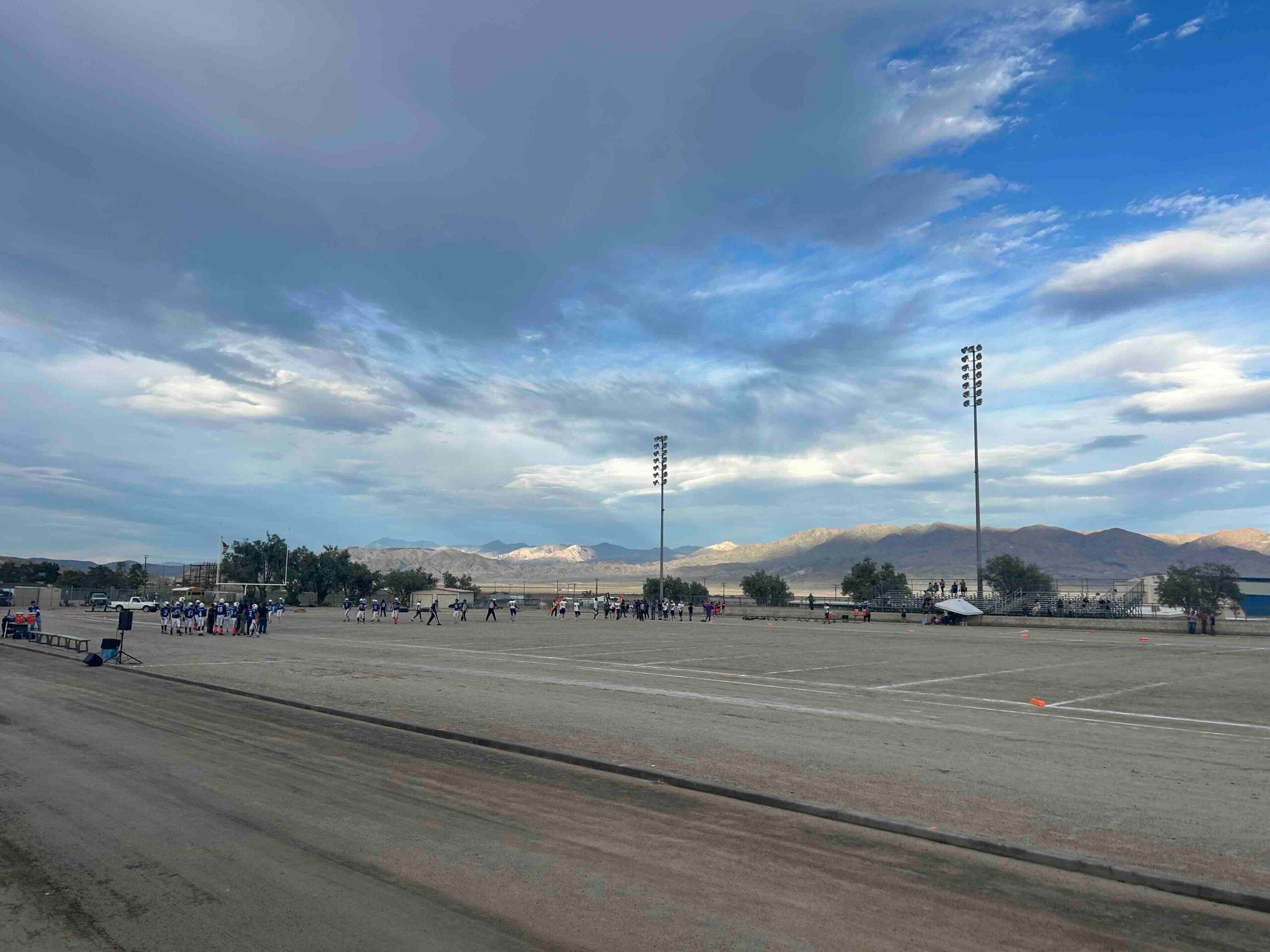
The white lines on the dirt football field were fresh, but by halftime they would be barely visible. It was homecoming weekend in Trona, an isolated community established in 1912 as a company town for the Searles Valley Minerals plant, which first opened as a potash plant before expanding into mining several other minerals, including borax, sodium sulfate, and soda ash.
These days, the plant is still in operation, but there are fewer jobs and therefore fewer people. Trona is geographically close to the border of Death Valley but ninety-seven miles from the touristy part of it, which means you wouldn’t necessarily pass through it or even learn of its existence if you visited the national park. I worked at a hotel in Death Valley for years and went to Trona only once during that time; a Blogspot-era photo essay had told me that its residents had all left mysteriously and simultaneously, which is not true. But I saw it as empty when I got there, because I was projecting some sinister stereotype—probably The Hills Have Eyes—onto its quiet streets, which is the exact kind of orientation a lot of people have toward the desert. Someone at work had told me that the high school’s football team played on the only dirt field in the United States.
Grass doesn’t grow in Trona. The same mineral-rich desert that drew people to the area for jobs at the plant makes the suburban lawn impossible. I live in Las Vegas now, and sometimes I walk down a street lined with artificial-turf yards and find myself in front of a real lawn that is so glossy, green, and lush it feels almost pornographic. Grass is a garish extravagance in the drought-ravaged west. Western cities like my own maintain golf courses and master-planned communities with man-made greenbelts, but they also maintain annual lists of individuals who use the most water. Grass isn’t native. It takes a lot of irrigation to keep it alive. But whether it’s about a status symbol, nostalgia for a childhood backyard, or stubborn delusion, some people are unwilling to live without it.
In Trona, they’ve been playing on the country’s only dirt football field for more than eighty years, and they’ve been living in a grassless place for much longer than that.
Richard Ancira played football in Trona in the late eighties and then returned as a coach from 2018 until 2021.
“That dirt is abrasive,” he told me. “You’re going to bleed. It’s not a matter of if, but when.”
No one calls what covers the field “soil,” which contains nutrients and ecosystems. It is dirt, which cannot support life. It is sand, the final form of eroded desert mountains—limestone and basalt and calcite and volcanic debris. And it contains salt, left over from a long-gone ocean.
I wondered, What about artificial turf? In 2019, Las Vegas converted twenty-seven high school football fields from grass to turf. The school district estimated that this saved 1.3 billion gallons of water, but coaches worried the material was too hot to play on in the summer. People criticize artificial turf for other reasons too. In 2023, the NFL Players Association called for the league to get rid of it entirely, claiming it was linked to noncontact injuries like torn Achilles tendons.
These might be Trona’s reasons for clinging to dirt, but Ancira thinks there’s something else. The dirt football field is a spectacle, a crucible, part of the legend of the place. He said, “It’s just part of the mystique.”
And it makes you tough, he kept telling me. Not just the dirt, but the heat. And even though I live in one of the fastest-warming cities in the country, I know that’s not the place he was talking about. In Las Vegas, we live in the air-conditioning. In Trona, especially on the football field, one lives outside of it, in the warming world.
“I’ve coached in July and August and I’ve seen temperatures of a hundred and twenty degrees,” Richard said. “I have friends that coach in LA, and if the temperature rises above a hundred and five, they can’t practice.”
“But we would never have a practice,” he said, “if we couldn’t practice in the heat.”
I arrived in Trona after dark with my husband, our dog, and our friend Sean, a former high school football coach who was bewildered by the dirt field. There were no hotels in town. We’d gotten lucky and booked the only Airbnb, a stucco house with a fenced-in yard of soft dirt. We tracked a veil of sand into the living room. It stuck to my skin, found its way into the bed even after a shower.
But outside there was starlight, the smell of a bonfire, the laughter of people gathering around it. The next morning at the homecoming day parade, the streets were lined with people in blue and white—the Trona Tornadoes’ colors. I found a spot facing the Searles Valley Minerals plant. The air smelled like sulfur, but after a few minutes, I got used to it. Plumes of white rose from a smokestack and there was a rattling. I asked a nearby man if he knew what the sound was, if it was always there, and he told me it was condensation.
“That means it’s making money,” he said, laughing.
While Trona is no longer a place where people are paid in scrip—the 1974 sale of the plant to the Kerr-McGee Chemical Corporation resulted in layoffs and a deliberate decision to end the company-town culture—there’s an understanding that the plant’s success is the community’s success.
The marching band passed by. In their glory days—someone told me those were the fifties—they performed in the Rose Parade. The school mascot, a grey tornado in a blue bandanna and a white bucket hat, trailed behind cheerleaders. The football players rode in on hay bales, followed by the homecoming queen, on the hood of a blue Ford Mustang. She wore a velvet cape trimmed with fur. A tiara sparkled atop her blond curls, the smokestacks of the plant blooming white above her as she tossed candy to the waiting children, who ran into the street to grab handfuls like I used to when I was a kid.
In a dirt lot near the plant, I met Alan Bengston and Carolyn Reed. They’ve known each other since their freshman year of high school—1964—but got engaged only recently, after reconnecting decades later. High school sweethearts, after all this time. The childhood they described was so quaint I felt like I was hearing about a black-and-white television show. They told me about movies, bowling, and dancing. Alan worked as a lifeguard at the pool and ran on the track team. “I conditioned best in the summer,” he said. “My mom would come out and say, ‘Are you trying to kill yourself? It’s a hundred and thirteen out.’ And I’d say, ‘It feels good, though.’ I got in great shape.”
Carolyn told me that her father had worked at the plant, hung the lights on the football field, and helped the local search and rescue find the Manson-family hideout in the nearby Panamint Mountains.
After the parade, at the history museum, people talked about a recent flood that had washed out the cemetery. The town rebuilt it together. I looked at photos of the mineral plant’s company baseball team, the Trona Tigers, who played from 1918 through the forties. An eighteen-hole golf course built in 1926 with no grass. The dirt football field, back when they used to play without padding, helmets, or even long pants. A docent told me that sometimes the Trona football players strategically kick up dust to distract their competitors. Playing dirty, he called it, smiling.
Officially, it’s Griffith Field, but everyone calls it the Pit—affectionately if they’re from Trona, derisively if they’re not.
“I don’t miss that rug burn,” a man in an I LOVE TRONA hat said. It was late October and still in the high eighties. My husband was back at the Airbnb, in the interest of keeping our dog somewhere air-conditioned. I thought about how in 2021, after Las Vegas banned ornamental grass, the patch outside our front door was replaced with rocks. I knew it was the right thing to do, but still I felt a private grief for the place where our dog could go out in the summer without burning his paws. I didn’t see a lot of dogs in Trona, and there was probably a reason for that.
My phone said it was eighty-six degrees, which was comfortable, but I was glad I wasn’t playing football. Sean and I found a shaded spot in the stands.
“Hope everyone’s got lots of sunblock on,” the announcer said.
The light was gold as the teenage athletes charged onto the field, the dust haloing around them. “Enter Sandman” by Metallica played, a nod to the football team’s nickname, the Sandmen. The away team was from Lone Pine, a town at the base of Mount Whitney that often serves as a filming location for Westerns—the kind of place that makes you open up Zillow on vacation. Trona, on the other hand, appears in YouTube videos with the words “Ghost Town” in the title. Sometimes, the people who make these videos walk into houses they think are abandoned. They can’t accept that someone might live there. But the Trona side of the stands was packed. By the second quarter, the canopy tent on the nearly empty away-team side had collapsed in the wind and was collecting sand. One of the Lone Pine players tripped, tumbling into the dirt. When he stood, his palms were bleeding. He coughed violently. The band played “Another One Bites the Dust.” I remembered something I’d overheard upon entering the Pit. When Trona players get tackled here, they instinctively hold their breaths to avoid inhaling dirt.
“People seem to fall more violently because of the sand,” Sean said. “It’s gladiatorial.” Trona was playing a flex-bone offense, he explained, which is about tricking the defense into misdirection. “It’s old-school,” he said. “You don’t see it much anymore. It’s not super orthodox.”
It was almost the end of the second quarter. Dust devils whirled on the field. The dry lake bed shimmered, and I could see the hazy outline of the Trona Pinnacles in the distance, a collection of tufa spires that rise up from the desert like otherworldly sentinels. I tried to pick out the canyons in the mountains across the Searles Valley. Hidden springs and wild burros. A pair of black ravens coasted in, riding the thermals, gliding above the game like they were watching it.
At halftime, Trona was down two points, but the collective mood remained jovial. We waited in the concessions line for sodas, eavesdropping on the people around us. There was a consensus among those who had grown up here and left; they wanted to move back.
A millennial-age man was telling a former classmate about a failed relationship with a waitress in a larger town. “I don’t know about all that,” he said. “I’m just a Trona boy.”
In the second half, the Tornadoes came back, scoring thirty-four points in the third quarter. When a nearby group rose to their feet to cheer, I noticed they were all wearing the same T-shirt. A green road sign indicating mileage. “End of the World: 10. Trona: 15.” A joke at the expense of everyone who had ever passed through town and called it apocalyptic. I looked back at the desert foothills, the big, white letter T above me. Some of the locals were going to climb up there to light it for homecoming, the steep scramble on loose rock just an ordinary tradition.
In the fourth quarter, another touchdown. The Trona cheerleaders rushed to the side of the field, stomping and chanting as if taunting Lone Pine. The away team was dejected and dusty, ready for the long ride home. The light shifted in those last few minutes, turning the pale dirt sepia. Shadows of clouds changed the shape of the mountains. The teenage girls who made up the homecoming court sat together in the sun, sequin dresses and hair-sprayed curls, hands in satin gloves folded patiently, awaiting victory. Thirty seconds. Twenty. Ten. And then it was three, two, one, everybody up, cheering loud enough to fill the valley.
Final score, 64–42, Trona.
That night at the Elks Lodge, we crashed a reunion party. I drank a Long Island iced tea from a plastic cup and talked to Kathy Williams, who moved to Trona in 1957, played clarinet in the high school marching band, and worked in the laboratory at the plant until retiring. She’d been there for the 2019 earthquakes—a 6.4, 5.4, and 7.1 that happened in quick succession, cracking open roads and knocking down walls—and when I asked her what it was like, I expected her to respond with something like terror. But instead she smiled. “I don’t know,” she said. “I was glad I was here for it. It was an experience.” The seismic activity in the area is just like the dirt; it’s part of living in Trona.
Late night, at the Trails Drive In, we sat at a table outside and ate mozzarella sticks, chicken tenders, and other kinds of fried and breaded food. The night was warm but not too windy. The dog pouted in the dirt, missing the soft carpet of Las Vegas. I told my husband that I was sorry he hadn’t been able to come sit in the bleachers with Sean and me.
“Actually,” he said. “It was pretty fun.” After it cooled down, he stood on the other side of the chain-link fence with our dog, intending on watching the high school game, but there was another game happening at the same time, unofficial and spontaneous. A group of Trona middle schoolers learning to play football in the dirt. The kids were fearless, vicious, and funny, kind of terrifying but full of life, tackling one another into the sand.
It reminded me of something Richard Ancira had told me about coaching in this particular environment. “It just makes the kids tough. Some of the toughest people I know are from that town. And I’m not talking like, you know, in a bar. I’m talking about all the way around. Just tough individuals mentally and physically, from growing up in that environment. That Trona environment.”
I saw it, too, from the crowd at the game. After they won, they stood looking at the desert, the town, their faces covered in dust. The white lines in the dirt were completely gone by then, the field empty. And though for most people, the word field brings to mind something green and soft, in Trona, it’s the Pit, and it’s made of rocks and dirt. The home field advantage isn’t obvious, but if you stay there long enough, you’ll see it.
Krista Diamond’s work has appeared in the New York Times, Cosmopolitan, Slate, and elsewhere. Her debut novel, Close Relationships with Strangers, will be published by Simon & Schuster this summer.